Artificial Intelligence Techniques for Prediction of Routing Scenarios in IoT-based MANETs using ERS, RED, and Global Pooling Dilated CNN: Trends and Challenges
DOI:
https://doi.org/10.65521/ijacect.v14i2.2749Keywords:
Abstract
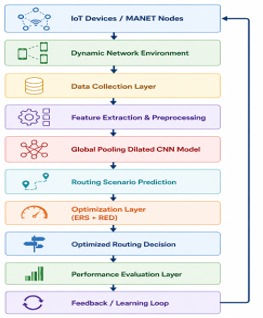
The rapid growth of Internet of Things (IoT) applications has increased the demand for intelligent routing mechanisms in Mobile Ad Hoc Networks (MANETs), which operate under dynamic topologies, decentralized control, and limited resources. Conventional routing protocols often fail to manage congestion, energy consumption, and frequent topology variations effectively, leading to reduced network performance. This review explores Artificial Intelligence (AI)-based techniques for routing prediction in IoT-enabled MANETs through the integration of Expanding Ring Search (ERS), Random Early Detection (RED), and global pooling dilated Convolutional Neural Networks (CNNs). Deep learning and reinforcement learning approaches are examined for their ability to extract spatial and temporal network features, enabling accurate prediction of link stability, congestion status, and optimal routing paths. ERS minimizes routing overhead by restricting unnecessary broadcasts, while RED improves congestion management through proactive queue control. The combined framework enhances packet delivery ratio, throughput, latency, and energy efficiency. The study also discusses emerging trends such as graph-based learning, edge intelligence, multi-agent learning, and security-aware routing. Key challenges including computational complexity, scalability, data dependency, and security issues are also highlighted for future intelligent routing system development.