
Classification of Multi Cancer using Deep Learning
DOI:
https://doi.org/10.65521/ijacect.v15i1.2350Keywords:
Abstract
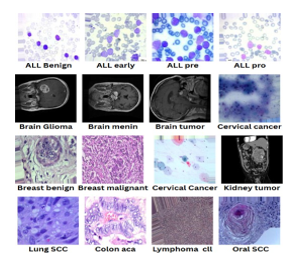
A significant challenge in computational pathology is accurate and efficient classification of multiple cancers which have enormous potential for early detection and improved patient outcomes. To identify eight types of cancers using a sizable collection of 1,30,000 histopathological images to identify various types of cancer, 3 deep learning models are compared. DenseNet201, MobileNetV2, and VGG16 were all trained and tested individually. Important performance metrics such as accuracy, loss and per-class precision were used to evaluate models, comprehensive findings are displayed in confusion matrices. According to our analysis, MobileNetV2 is the most effective model, with the lowest loss of 0.0016 and the highest accuracy of 0.9998. Next was VGG16, which had a loss of 0.0058 and an accuracy of 0.9990. Despite having a high accuracy of 0.9980, DenseNet201’s loss graphs indicated some instability during validation. MobileNetV2’s reliable nature was demonstrated by the confusion matrix, which revealed it had few errors. These findings demonstrate that MobileNetV2 is most reliable and efficient option for this kind of cancer classification, making it a solid contender for application in automated diagnostic systems.
Downloads
Published
How to Cite
Issue
Section
License

This work is licensed under a Creative Commons Attribution-NoDerivatives 4.0 International License.
