
Design and Implementation of a Boosting-Based Machine Learning Framework for Hypertension Classification
DOI:
https://doi.org/10.65521/ijacect.v14i2.1894Keywords:
Abstract
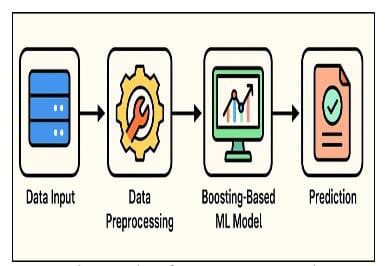
Hypertension, a leading cause of cardiovascular morbidity and mortality worldwide, demands early and accurate diagnosis to prevent life-threatening complications. Traditional diagnostic approaches rely heavily on manual interpretation of physiological parameters, which may lead to misclassification due to human error and lack of contextual analysis. To address these challenges, this research proposes a boosting-based machine learning framework for efficient hypertension classification. The study used benchmark dataset as Hypertension Risk Prediction Dataset. The data undergoes extensive preprocessing involving cleaning, normalization, and feature selection to enhance model performance. The proposed framework employs ensemble boosting algorithms AdaBoost, XGBoost, and LightGBM to capture nonlinear relationships among features and improve predictive accuracy. Each algorithm is optimized through systematic hyperparameter tuning and cross-validation. Comparative evaluation reveals that boosting-based models outperform conventional single classifiers in terms of precision, recall, F1-score, and overall classification accuracy. The framework also incorporates feature engineering techniques to identify the most influential risk factors contributing to hypertension, offering interpretability for clinical decision support. Results indicate that XGBoost achieves the best trade-off between performance and computational efficiency.
Downloads
Published
How to Cite
Issue
Section
License

This work is licensed under a Creative Commons Attribution-NoDerivatives 4.0 International License.
