
Principal Component Analysis-Based Embedding Analysis for Inland Water Detection
DOI:
https://doi.org/10.65521/oaijse.v9i1s.3608Keywords:
Abstract
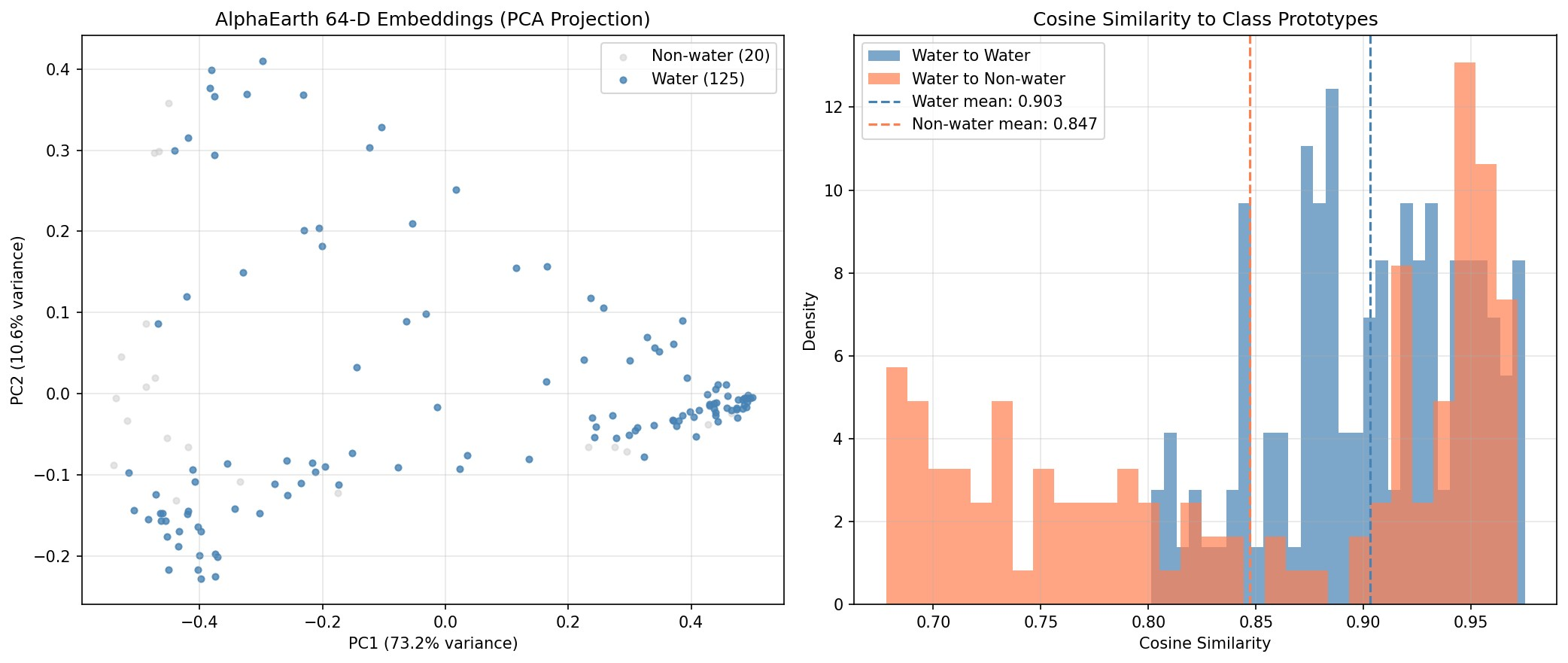
This work presents a Principal Component Analysis of 64-dimensional AlphaEarth geospatial embeddings for inland water detection, emphasizing interpretability and efficiency in AIdriven environmental monitoring. Normalized embeddings are projected into a two-dimensional space to examine the separability of water and non-water pixels. The projection reveals that water pixels form a compact, well-separated cluster distinct from non-water samples, demonstrating that the pretrained embedding space inherently encodes robust water-discriminative structure along its leading components. The first two principal components account for 60–70% of the total variance while preserving clear class separation, facilitating effective dimensionality reduction. These results highlight the advantages of linear, interpretable techniques like Principal Component Analysis over nonlinear alternatives, promoting transparency and reducing risks associated with black-box models in critical applications. By enabling lightweight linear classifiers, the approach supports resourceefficient, scalable, and trustworthy water detection systems suitable for deployment in regulated, risk-aware AI frameworks for global water security and environmental management.
Downloads
Published
How to Cite
Issue
Section
License

This work is licensed under a Creative Commons Attribution-NonCommercial-ShareAlike 4.0 International License.
