
Privacy-Preserving Federated Learning Framework for Intelligent Cyber Threat Detection in Distributed Networks
DOI:
https://doi.org/10.65521/oaijse.v9i5.3233Keywords:
Abstract
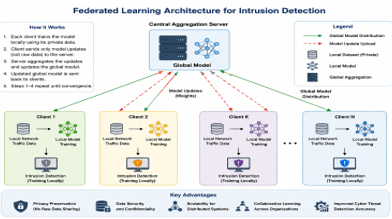
Cyber threats keep going up in modern distributed network environments, so yeah, classic intrusion detection systems are, kind of, less effective when attacks keep changing. A lot of machine learning security methods depend on centralized data gathering, and that ends up raising real worries about privacy, confidentiality, and data security, especially when there is sensitive traffic involved. So in order to deal with these issues, this paper puts forward a privacy-preserving federated learning setup for intelligent cyber threat detection across distributed networks. With the proposed idea, several client nodes can work together to train one global intrusion detection model, but they don’t need to share raw network data between them, which is the main point.
Machine learning techniques are then used with benchmark intrusion detection datasets, for efficiently separating normal from malicious network traffic. On top of that, feature preprocessing along with model optimization are included, to boost detection performance and also trim down computational complexity. Overall, the federated learning architecture improves data privacy, scalability, and collective intelligence, while still keeping a high detection accuracy. And finally, the framework offers a secure and practical path for real world cybersecurity work, like IoT networks, enterprise infrastructure, and cloud based distributed systems.
Downloads
Published
How to Cite
Issue
Section
License

This work is licensed under a Creative Commons Attribution-NonCommercial-ShareAlike 4.0 International License.
