
A Hybrid Explainable Framework for Resume Screening and Candidate–Job Matching Using Semantic Similarity
DOI:
https://doi.org/10.65521/oaijse.v9i5.3186Keywords:
Abstract
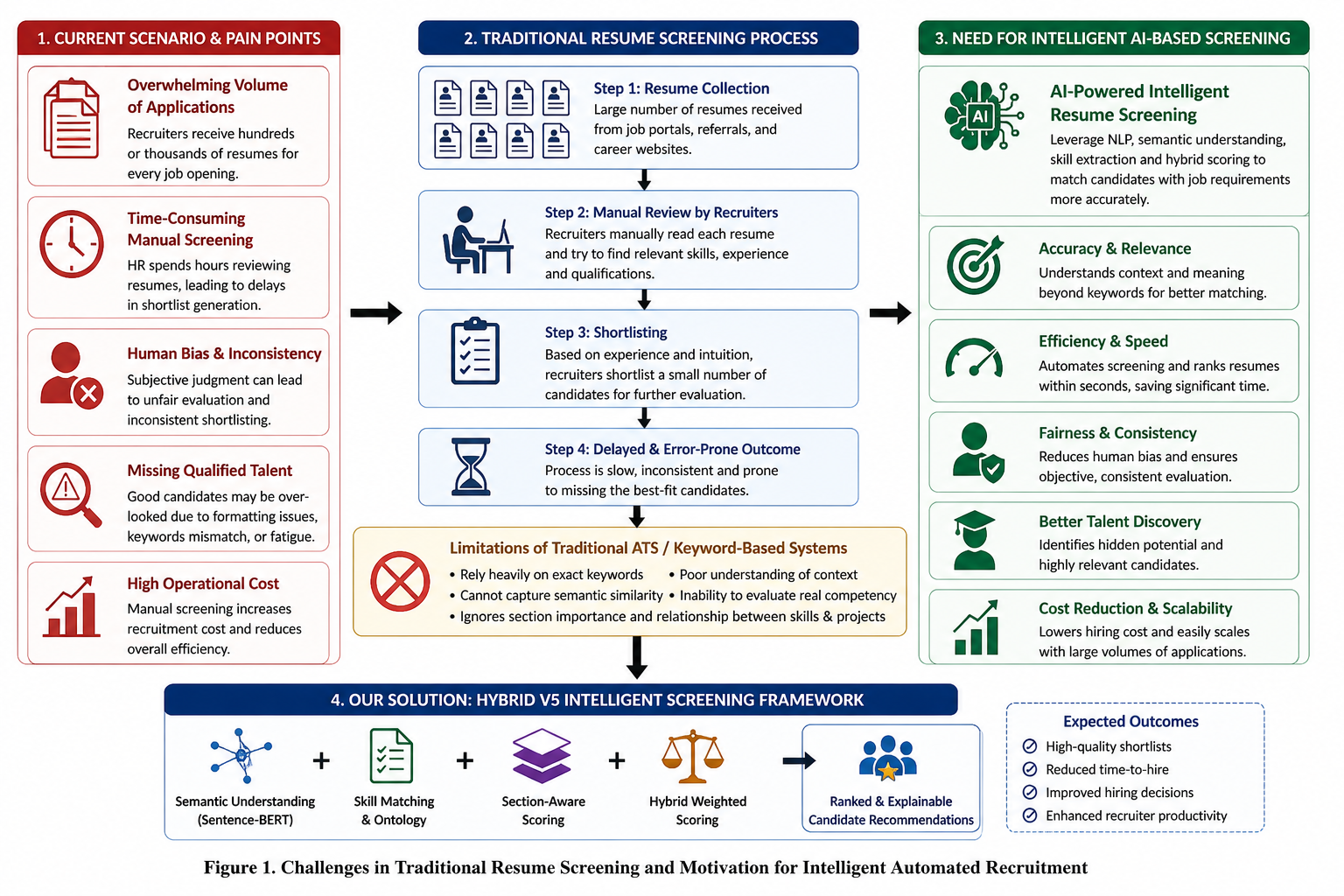
The increasing use of online hiring platforms has created a situation where employers receive an exceptionally large number of applications for each vacancy. While this expands access to talent, it also makes the initial screening stage more difficult and time-consuming. Recruiters often need to review many resumes in a brief period, which can lead to inconsistent decisions and the possibility of overlooking qualified candidates. Although automated Applicant Tracking Systems are commonly used, many available tools still depend heavily on keyword filtering or simple rule-based logic. These approaches may fail when candidates describe their skills using different wording or when relevant experience is expressed indirectly. To improve this process, this study develops a hybrid and explainable framework for resume screening and candidate–job matching based on semantic understanding and structured ranking criteria. The proposed system compares resumes with job requirements using Sentence-BERT embeddings, which allow text to be matched according to meaning rather than exact word repetition. This helps identify suitable candidates even when resumes and job descriptions use different terminology. In addition, the framework includes a skill analysis module that detects technical competencies such as programming languages, frameworks, databases, and cloud tools, then measures how closely they align with employer expectations. Resume content is also examined section by section, giving separate importance to skills, projects, experience, and education. These signals are combined through a weighted ranking method to generate final recommendations. To make results easier to trust and interpret, the system also provides explanations for each recommendation by highlighting missing or relevant skills. A fairness check is included to observe whether rankings remain stable after removing personal identity information. The framework was implemented in Python using Google Colab and supports resumes in both PDF and DOCX formats. Experimental testing on representative resumes and company profiles from multiple technical domains showed that the model produced relevant top-ranked matches and performed better than semantic-only matching in comparative analysis. The proposed framework offers a practical, transparent, and scalable solution for campus placements, startup hiring, and modern recruitment environments, while also creating opportunities for future work using larger datasets and advanced ranking methods.
Downloads
Published
How to Cite
Issue
Section
License

This work is licensed under a Creative Commons Attribution-NonCommercial-ShareAlike 4.0 International License.
