
Game-Theoretic and Graph-Based Artificial Intelligence Approaches for Proactive Cyber Defense: A Contemporary Literature Review
DOI:
https://doi.org/10.65521/oaijse.v9i5.2846Keywords:
Abstract
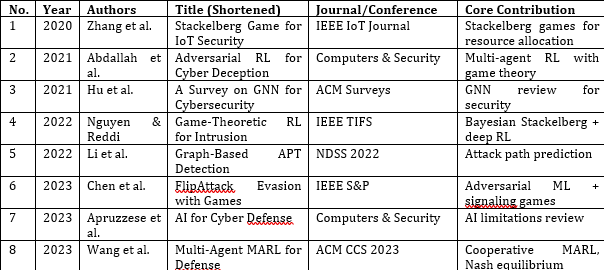
The rapid progress of AI-based cyber-attacks has made conventional reactive security measures less effective. There has been a growing trend in recent research work (2020-2025) to combine game theory, artificial intelligence (machine learning, deep learning, and reinforcement learning), and graph theory to develop proactive and adaptive cybersecurity systems. This literature review systematically analyses 25 high-impact studies published in the last five years, categorized into game-theoretic models, AI-enhanced cyber defense, graph-based attack modeling, and integrated approaches. Results show that there have been major breakthroughs in Stackelberg and Bayesian games, multi-agent reinforcement learning, graph neural networks, and hybrid models, but there is a definite research gap in scalable and real-time frameworks that can effectively utilize all three paradigms. This paper will identify the research gap and provide future research directions.
Downloads
Published
How to Cite
Issue
Section
License

This work is licensed under a Creative Commons Attribution-NonCommercial-ShareAlike 4.0 International License.
