Performance Analysis of Grid-Connected Solar Photovoltaic Systems
DOI:
https://doi.org/10.65521/itsi-teee.v7i1.4232Keywords:
Abstract
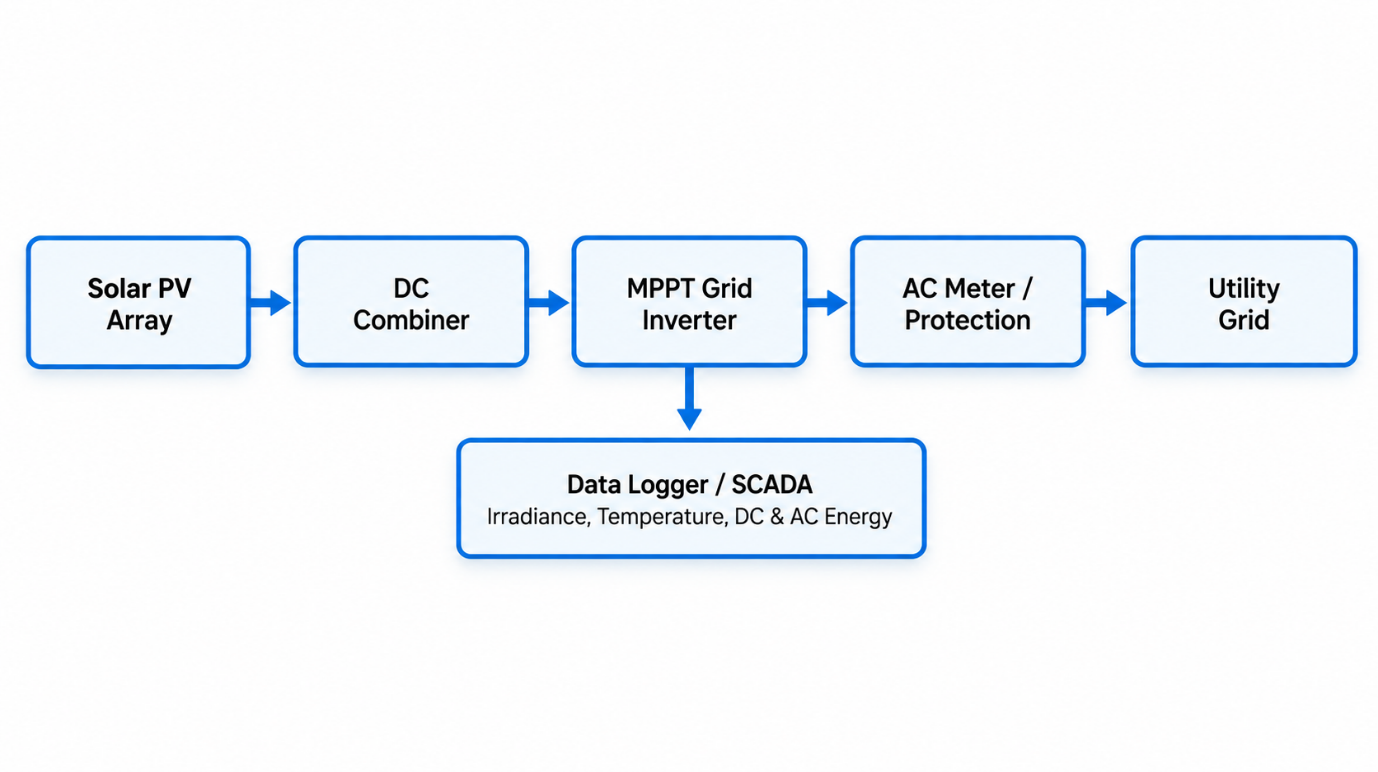
Grid-connected solar photovoltaic (PV) systems have become a major option for distributed and utility-scale electricity generation; however, their real energy contribution depends on solar resource, module temperature, conversion losses, inverter operation, grid availability, soiling, and system design. This paper presents a compact methodology for evaluating the technical performance of a grid-connected PV system using internationally adopted normalized indicators. The proposed procedure combines monitored solar irradiance, ambient and module temperature, DC energy, AC energy, and grid-side operating data. Reference yield, array yield, final yield, capture loss, system loss, performance ratio, capacity factor, PV array efficiency, inverter efficiency, and overall system efficiency are calculated on daily, monthly, and annual bases. A representative 100 kWp plant is used to demonstrate the analytical workflow; the numerical results are illustrative rather than field measurements from a named site. For the representative year, the method gives a specific AC yield of about 1,585 kWh/kWp, an annual performance ratio of 78.0%, a capacity factor of 18.1%, and an average inverter efficiency of 96.2%. The framework also separates environmental losses from balance-of-system losses so that underperformance can be diagnosed rather than reported only as reduced energy output. The approach is consistent with performance studies published up to 2018 and is suitable for rooftop as well as utility-scale systems.