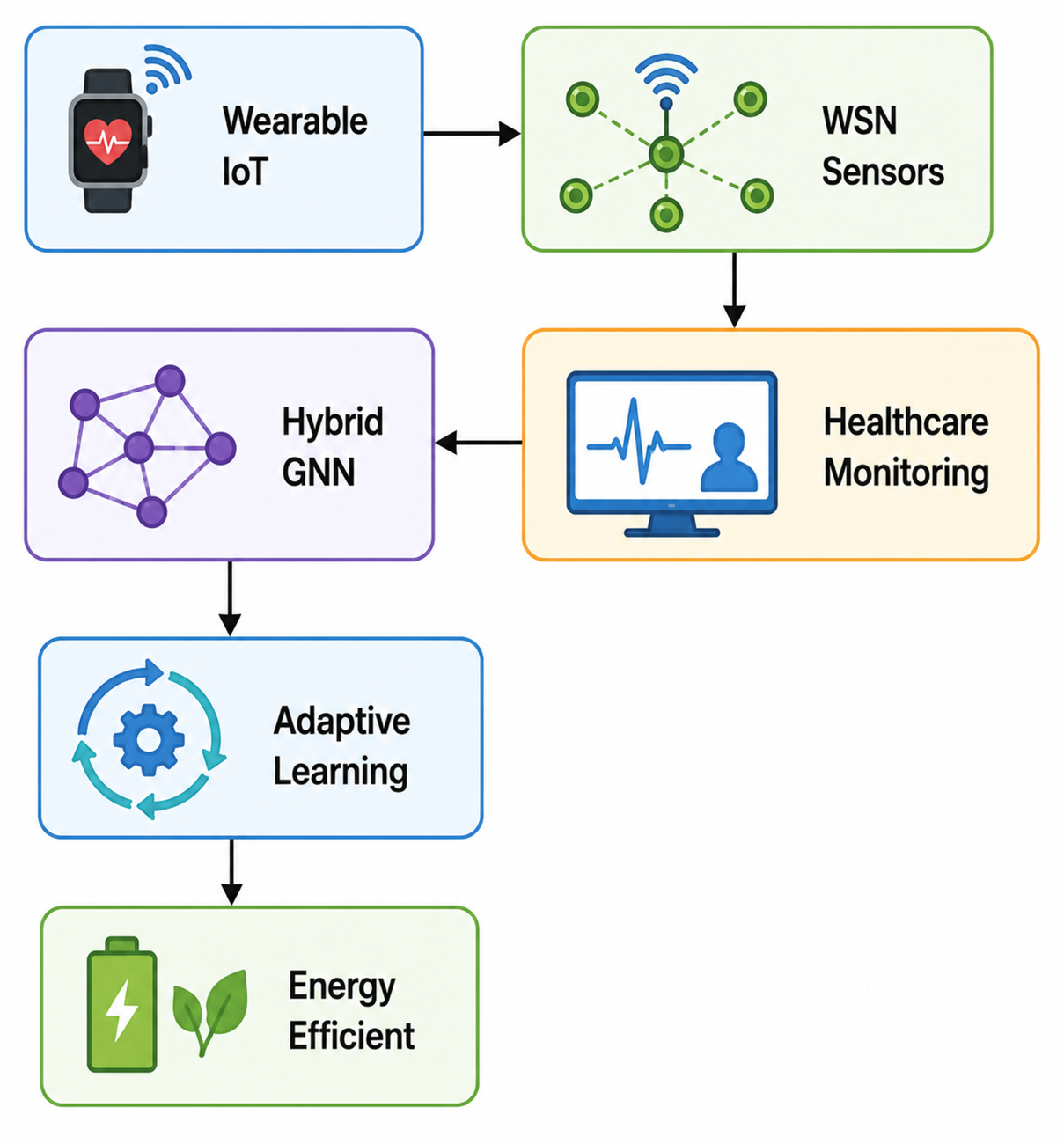
Deep Learning and Optimization Approaches in Hybrid Graph Neural Networks for Wearable IoT Monitoring Systems with Adaptive Algorithms and Energy-Efficient WSN Integration: A Review
DOI:
https://doi.org/10.65521/itsi-teee.v12i2.3899Keywords:
Abstract
The rapid evolution of wearable Internet of Things (IoT) monitoring systems has transformed healthcare, enabling continuous patient monitoring, real-time diagnostics, and intelligent decision-making. Wireless Sensor Networks (WSNs) serve as the backbone of these systems, facilitating seamless data collection and transmission. However, challenges such as energy efficiency, scalability, computational complexity, and real-time processing remain critical barriers. Deep learning techniques, particularly Graph Neural Networks (GNNs), have emerged as powerful tools for modelling complex relationships in interconnected IoT environments. GNNs are capable of capturing spatial and temporal dependencies in sensor networks, enabling efficient data analysis and prediction. Hybrid GNN architectures combined with optimization techniques such as reinforcement learning, evolutionary algorithms, and adaptive routing strategies have demonstrated significant improvements in energy efficiency and network performance. For instance, hybrid GNN-based approaches can optimize power allocation and communication efficiency in wireless networks, enhancing scalability and robustness. In wearable IoT systems, energy efficiency is a critical factor due to limited battery capacity of sensor nodes. Advanced energy-efficient routing protocols and data aggregation techniques have been developed to extend network lifetime and reduce energy consumption. This review presents a comprehensive analysis of deep learning and optimization approaches in hybrid graph neural networks for wearable IoT monitoring systems integrated with energy-efficient WSNs. It highlights recent advancements, compares methodologies, identifies research gaps, and discusses future directions. The study emphasizes the importance of combining GNN-based intelligence, adaptive algorithms, and energy-efficient networking to develop scalable and reliable IoT healthcare systems.