A Survey of Methods and Architectures for Efficient Resource Management in 6G Communication Networks Using a Hybrid Quantum Duplet-Convolutional Neural Network Model
DOI:
https://doi.org/10.65521/itsi-teee.v13i2.3855Keywords:
Abstract
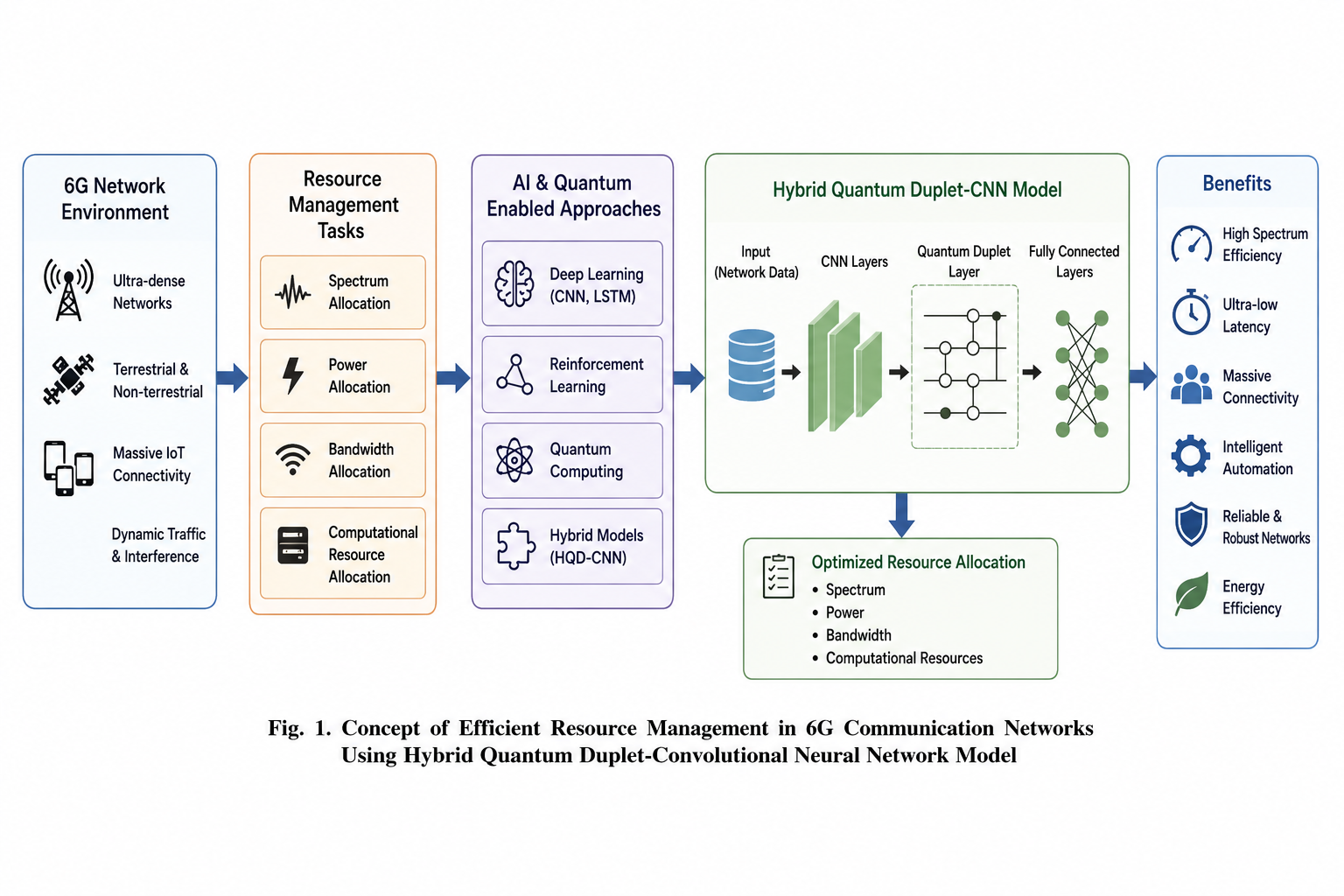
The evolution toward sixth-generation (6G) communication networks introduces unprecedented challenges in resource management due to ultra-dense connectivity, heterogeneous architectures, and strict performance requirements such as ultra-low latency and high reliability. Traditional optimization-based resource management approaches are insufficient for handling the dynamic and complex nature of 6G systems. Consequently, Artificial Intelligence (AI), deep learning, and quantum computing have emerged as promising solutions.This paper presents a comprehensive survey of methods and architectures for efficient resource management in 6G communication networks, with a focus on hybrid quantum duplet-convolutional neural network (HQD-CNN) models. The study systematically reviews literature, covering optimization-based techniques, machine learning, deep learning, reinforcement learning, and quantum-enhanced frameworks.The findings indicate that AI-driven approaches significantly improve network performance by enabling adaptive and intelligent decision-making. In particular, deep reinforcement learning and hybrid CNN-based architectures demonstrate superior capabilities in handling dynamic resource allocation, network slicing, and interference management. Furthermore, hybrid quantum deep learning models leverage quantum parallelism to solve complex optimization problems more efficiently than classical approaches, improving QoS and reducing latency.
Despite these advancements, several challenges remain, including computational complexity, quantum hardware limitations, scalability issues, and security concerns. The paper concludes by identifying future research directions, emphasizing AI-native 6G architectures, federated learning, and scalable quantum-assisted optimization.