Finite Element Analysis of Automotive Suspension Components Under Dynamic Loading Conditions
DOI:
https://doi.org/10.65521/ijtarme.v8i1.4409Keywords:
Abstract
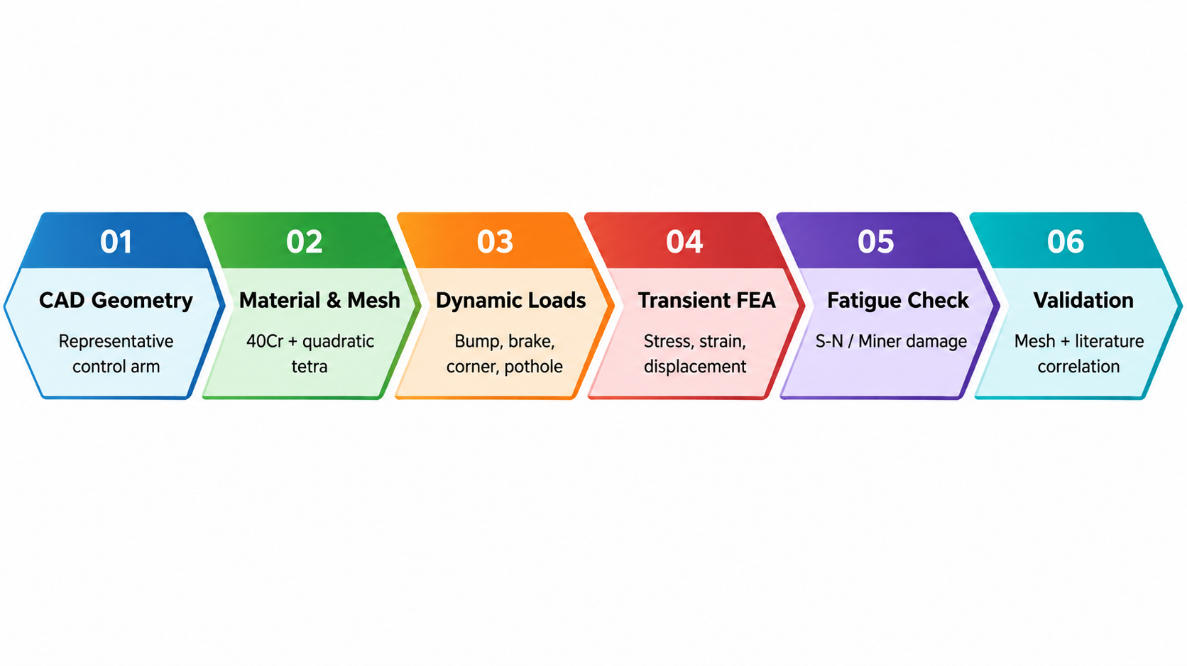
Automotive suspension components are exposed to repeated vertical impact, braking, cornering and road-induced loads, making stress concentration and fatigue durability central design concerns. This methodology paper presents a finite element analysis (FEA) framework for evaluating a representative MacPherson-type lower control arm under combined dynamic loading. The procedure integrates CAD idealization, material assignment, mesh-convergence verification, transient structural analysis, modal screening and fatigue-life estimation from variable-amplitude loads. A 40Cr steel control arm is used as the representative component, while road events are represented by bump, braking, cornering and pothole load cases derived from a 1200 kg passenger vehicle with a 55% front-axle load share. Dynamic force histories are applied at the ball-joint interface while realistic bushing constraints are retained to avoid artificial over-stiffening. Equivalent von Mises stress, total deformation, safety factor and cumulative fatigue damage are used as response measures. The illustrative numerical case identifies the pothole event as the critical transient condition, with local stress concentration occurring around the ball-joint transition and bushing fillets. The framework provides a compact, reproducible basis for suspension durability assessment and for later topology or material optimization.