
AI-Based Research and Experimental Analytical Assessment of Environmental and Economic Impacts of Fly Ash Utilization in Building Projects
DOI:
https://doi.org/10.65521/intjournalrecadvengtech.v15i1.1535Keywords:
Abstract
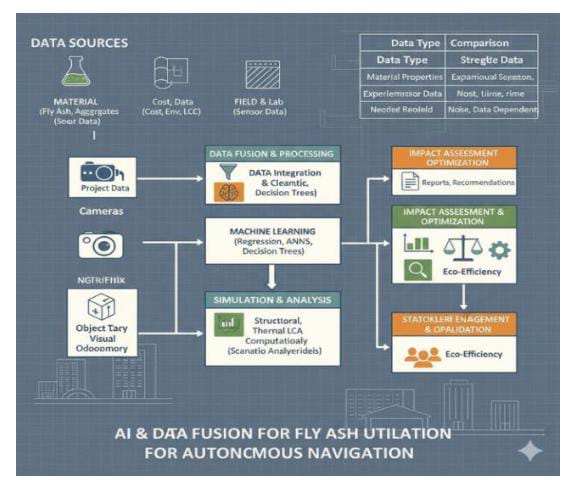
The construction industry significantly contributes to global carbon emissions, primarily due to the extensive use of Ordinary Portland Cement (OPC) in conventional concrete (CC). Cement manufacturing is energy-intensive and responsible for substantial CO₂ emissions, leading to environmental degradation and climate change. Additionally, conventional concrete exhibits durability challenges when exposed to aggressive environmental conditions such as sulfate attack, acid exposure, and high temperatures. In this context, Geopolymer Concrete (GPC), synthesized using industrial by-products such as fly ash and Ground Granulated Blast Furnace Slag (GGBS) activated by alkaline solutions, has emerged as a promising sustainable alternative. This research presents an AI-based research and experimental analytical assessment of the environmental and economic impacts of fly ash utilization in building projects by comparing GPC with conventional M-30 grade concrete. The experimental methodology involves the design and development of M-30 grade GPC using fly ash and GGBS as binder materials activated with sodium hydroxide (NaOH) and sodium silicate (Na₂SiO₃) solutions. Mechanical performance will be evaluated using compressive, split tensile, and flexural strength tests on cube, cylinder, and beam specimens. Durability assessment will include water absorption tests to evaluate porosity and permeability, acid and sulfate resistance tests to analyze chemical durability, and thermal resistance tests to assess performance under elevated temperatures. Furthermore, a comprehensive Life Cycle Assessment (LCA) will be conducted to quantify CO₂ emissions, embodied energy, and environmental impacts associated with both GPC and CC. AI-based analytical modeling techniques will be employed to predict performance trends, optimize mix proportions, and evaluate sustainability indicators. The proposed work aims to establish a comparative framework for assessing strength, durability, carbon footprint, and cost-effectiveness of GPC and CC. Expected outcomes include significant reduction in CO₂ emissions due to partial or complete replacement of OPC, improved resistance to aggressive environments, enhanced thermal stability, and long-term economic benefits through reduced maintenance and lifecycle costs. AI-driven analysis is anticipated to improve predictive accuracy and decision-making for sustainable construction practices. The study concludes by proposing geopolymer concrete as a technically viable, environmentally sustainable, and economically feasible alternative to conventional concrete for structural applications, particularly in M-30 grade construction, without compromising mechanical performance and durability.
Downloads
Downloads
Published
How to Cite
Issue
Section
License

This work is licensed under a Creative Commons Attribution-NoDerivatives 4.0 International License.
