Machine Learning-Based Fault Diagnosis of Rotating Mechanical Equipment
Keywords:
Abstract
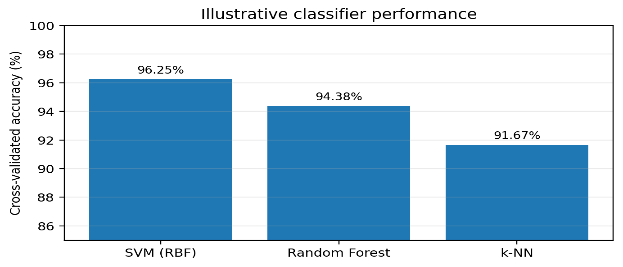
Rotating mechanical equipment such as motors, pumps, gearboxes and bearing-supported shafts can develop faults that generate subtle changes in vibration signals before functional failure. This paper presents a step-by-step machine-learning methodology for vibration-based fault diagnosis, combining signal conditioning, engineered time- and frequency-domain features, feature scaling, supervised classification and cross-validated performance assessment. The literature foundation is restricted to studies published up to 2020. To demonstrate the methodology without presenting fabricated field measurements, a reproducible simulation-based case study is used with four operating states: healthy, imbalance, misalignment and bearing fault. One-second vibration segments are generated under speed, amplitude and noise variability; twelve diagnostic features are extracted and three conventional classifiers are compared using stratified five-fold cross-validation. In the illustrative experiment, the radial-basis-function support vector machine achieved 96.25% accuracy, followed by random forest at 94.38% and k-nearest neighbours at 91.67%. The strongest residual confusion occurred between healthy and imbalance conditions, while misalignment was separated consistently. The results show how a transparent feature-based workflow can support fault diagnosis when datasets are limited, while also providing a baseline for later deep-learning or transfer-learning extensions. The proposed framework is suitable as a methodology template for laboratory validation and subsequent industrial deployment.