Influence of Alumina Nanoparticle Concentration on Heat Transfer and Flow Resistance in a Double-Pipe Heat Exchanger
Keywords:
Abstract
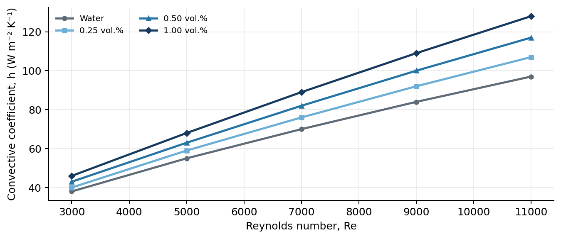
Nanofluid concentration can significantly influence both heat-transfer capability and hydraulic resistance in heat-exchanger systems. This study presents an experimental methodology for investigating the effect of Al₂O₃ nanoparticle concentration on thermal and flow performance in a double-pipe counter-flow heat exchanger. De-ionized water is considered as the reference fluid and is compared with Al₂O₃–water nanofluids containing 0.25, 0.50, and 1.00 vol.% nanoparticles over Reynolds numbers ranging from 3,000 to 11,000. The experimental procedure includes controlled inlet temperatures, calibrated temperature and flow measurements, differential-pressure monitoring, characterization of nanofluid thermo-physical properties, repeated runs, and rejection of tests exceeding a 5% heat-balance error. The measured data are used to determine heat duty, convective heat-transfer coefficient, Nusselt number, friction factor, exchanger effectiveness, and a combined thermal-hydraulic performance criterion. Representative results indicate that increasing both Reynolds number and particle concentration produces higher heat-transfer coefficients, but also increases flow resistance. At a Reynolds number of approximately 11,000, the illustrative 1.00 vol.% nanofluid case provides a heat-transfer coefficient of 128 W m⁻² K⁻¹ compared with 97 W m⁻² K⁻¹ for water, corresponding to an improvement of about 32%. At the same condition, pressure drop increases from 12.8 to 15.1 kPa, representing an approximately 18% hydraulic penalty. The resulting performance criterion of 1.25 indicates a favorable net thermal-hydraulic effect under the adopted evaluation approach. The proposed methodology provides a systematic framework for assessing the combined effects of nanoparticle loading, flow condition, suspension stability, uncertainty, and pumping penalty in nanofluid heat-exchanger applications.