Development of an Intelligent Traffic Management System Using Wireless Sensor Networks
DOI:
https://doi.org/10.65521/ijeecs.v10i1.4530Keywords:
Abstract
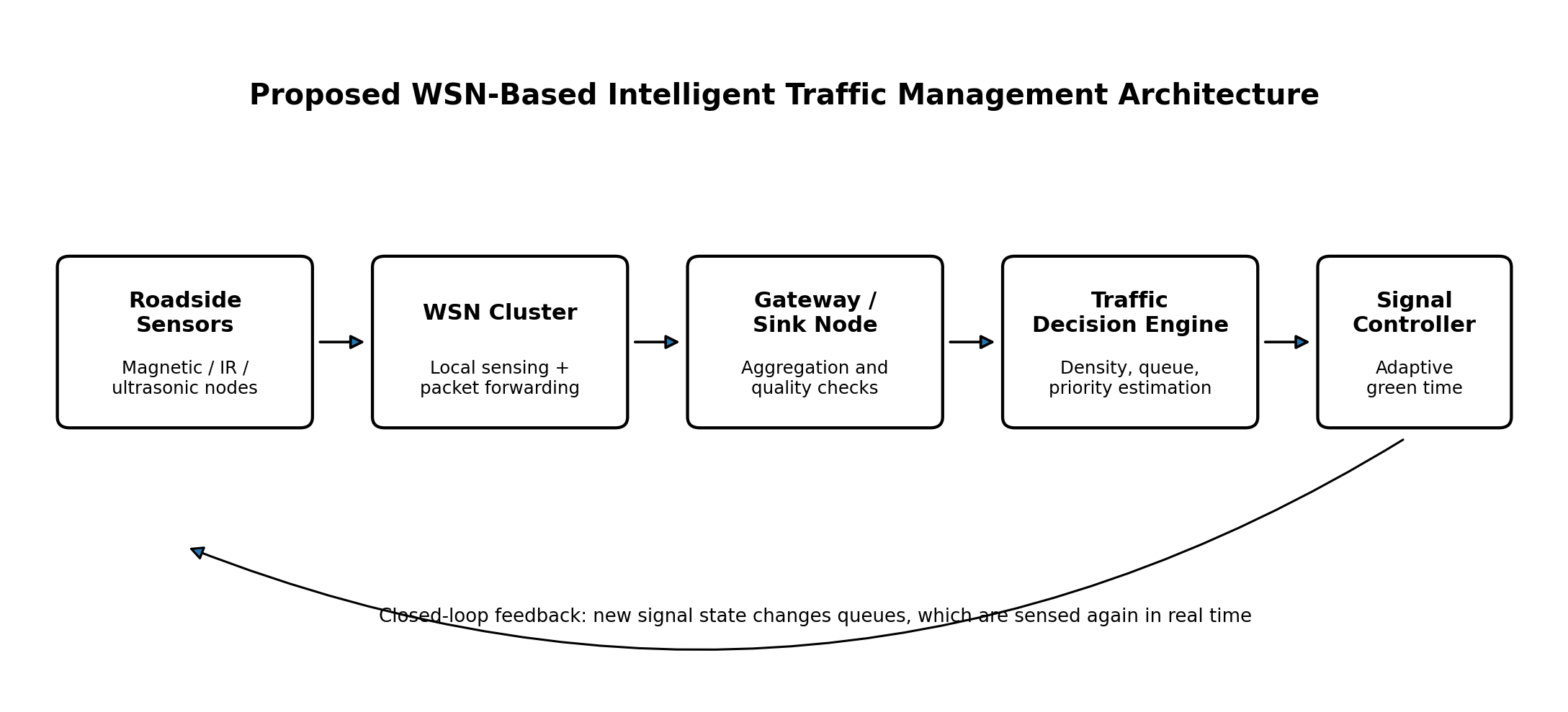
Urban intersections are frequently controlled by fixed signal plans that cannot respond effectively to short-term variations in vehicle demand. This methodology paper develops a wireless sensor network (WSN)-based intelligent traffic management framework in which low-power roadside sensor nodes measure vehicle presence and queue conditions, forward observations through clustered wireless links, and support a controller that adjusts signal green time according to current traffic pressure. The proposed study uses a design-science and simulation methodology rather than claiming field deployment. Its architecture combines sensing, data aggregation, congestion estimation, adaptive phase selection, emergency-priority logic, and performance logging. A one-hour microscopic time-step simulation is repeated thirty times for light, medium, and heavy traffic conditions and is compared with a conventional equal-split fixed-time controller. Under the stated assumptions, the adaptive controller reduces mean waiting time from 12.39 to 7.77 s in light demand, from 15.30 to 11.18 s in medium demand, and from 82.59 to 61.67 s in heavy demand, while also reducing average queue size and improving heavy-load throughput. The results support the methodological feasibility of using WSN measurements for responsive traffic signal control, while emphasizing that communication loss, sensor error, multi-intersection coordination, security, and real-world calibration must be addressed before field implementation.