IoT-Based Smart Energy Monitoring and Management System for Residential Buildings
DOI:
https://doi.org/10.65521/ijeecs.v9i1.4525Keywords:
Abstract
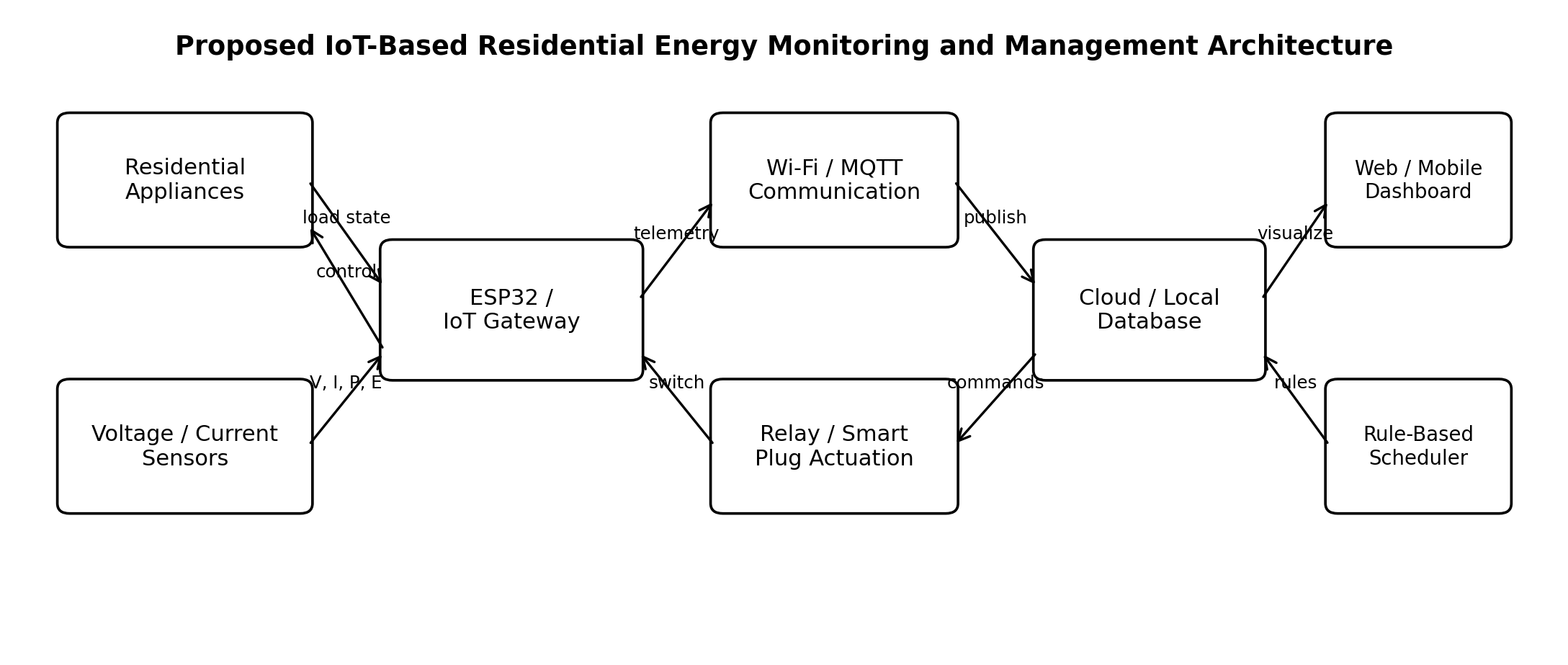
Residential buildings increasingly require continuous visibility of electricity use and low-cost mechanisms for reducing avoidable consumption. This methodology paper proposes an Internet of Things (IoT)-based smart energy monitoring and management system that combines electrical sensing, an ESP32-class gateway, wireless communication, cloud/local data storage, a dashboard, and relay-based load control. The method is designed to acquire voltage, current, active power, and cumulative energy at appliance or circuit level, transmit readings at short intervals, detect threshold violations, and schedule flexible loads outside high-demand periods. The proposed evaluation uses a representative seven-day residential load profile and compares an unmanaged baseline with rule-based management. Performance is assessed through metering error, communication success rate, peak demand, total energy, estimated electricity cost, and user-service constraints. The simulation-based validation indicates that the proposed workflow can reduce peak demand and unnecessary energy use while preserving essential loads. The paper also identifies privacy, interoperability, network reliability, and device calibration as major implementation issues. The methodology is intentionally based on technologies and research available by 2020 so that the design is reproducible for studies using that literature boundary