Design and Implementation of an IoT-Based Smart Energy Monitoring System
DOI:
https://doi.org/10.65521/ijeecs.v7i1.4502Keywords:
Abstract
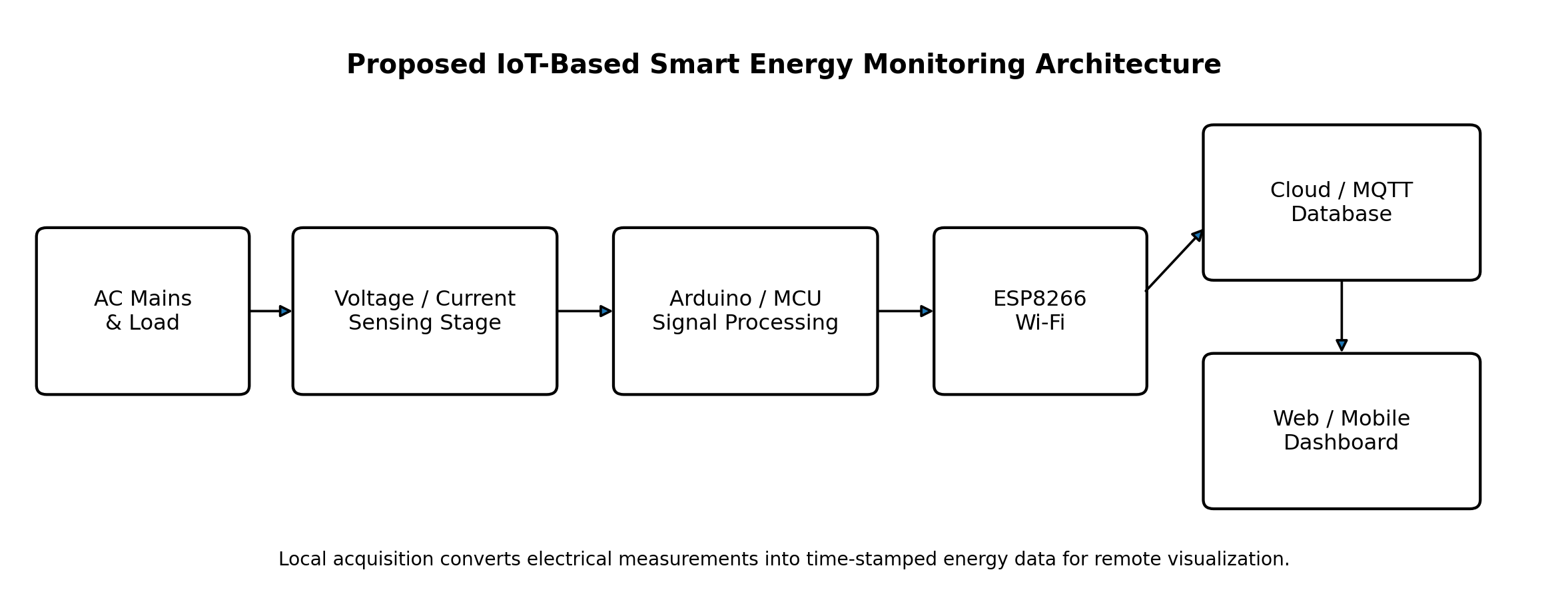
The increasing penetration of connected devices and smart meters has created an opportunity to move electricity monitoring from periodic billing toward continuous, user-oriented feedback. This methodology paper presents the design and implementation framework of a low-cost Internet of Things (IoT)-based smart energy monitoring system suitable for residential and small commercial loads. The proposed architecture combines voltage and current sensing, embedded signal processing, Wi-Fi communication, cloud data storage, and a web/mobile dashboard. The methodology covers sensor calibration, acquisition of instantaneous voltage and current, computation of root-mean-square quantities and real power, energy integration, packet formation, cloud transmission, visualization, and validation against reference measurements. A 2010–2018 literature base is used to position the design within IoT architecture, smart metering, demand-side management, home energy management, and energy-disaggregation research. To avoid overstating empirical evidence, the numerical results are presented as an illustrative bench-test/simulation dataset based on known appliance ratings and controlled measurement error. The analysis indicates that an IoT monitoring node designed around periodic sampling and local computation can provide near-real-time consumption visibility, event logging, and threshold alerts while maintaining a simple communication load. The methodology is intended as a reproducible foundation for later hardware validation, demand-response integration, and appliance-level analytics.