Performance Analysis of Solar Photovoltaic Systems Under Variable Environmental Conditions
DOI:
https://doi.org/10.65521/ijeecs.v7i1.4499Keywords:
Abstract
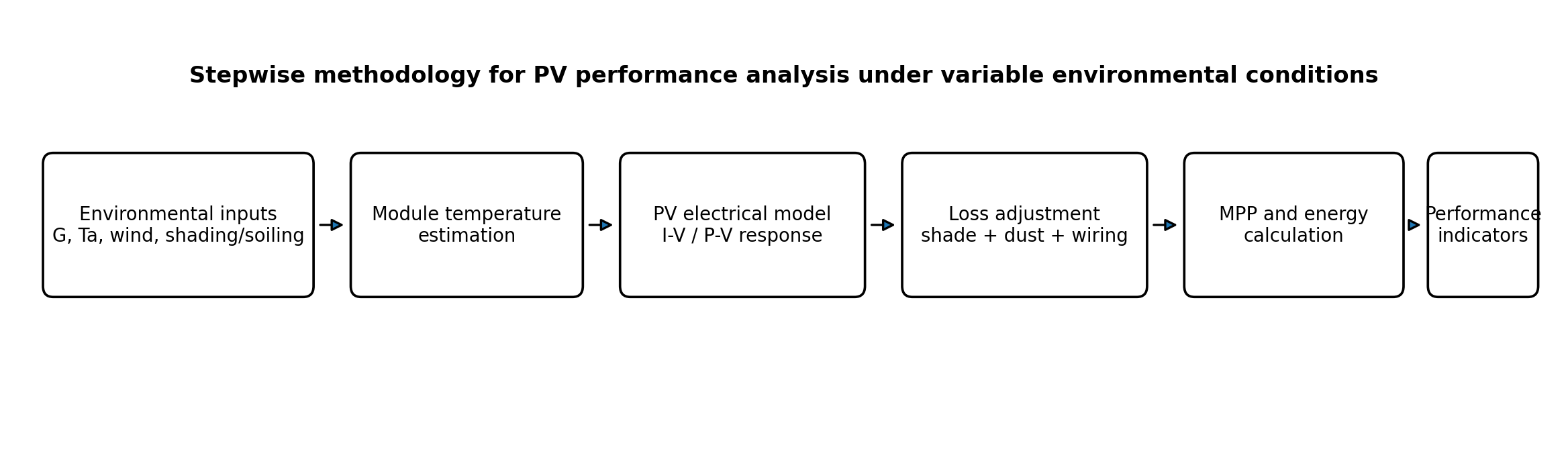
Solar photovoltaic (PV) output is highly sensitive to environmental conditions because irradiance, module temperature, wind, partial shading, and surface soiling alter the current-voltage operating point and the amount of useful energy that can be extracted. This methodology paper develops a compact and reproducible framework for evaluating PV performance under variable outdoor conditions using measured or representative meteorological inputs, a temperature-corrected electrical model, and normalized performance indicators. The procedure combines irradiance normalization, module-temperature estimation, maximum-power calculation, and explicit loss factors for shading and soiling. A 250 Wp crystalline-silicon module is used as an illustrative case to demonstrate the analysis over irradiance levels of 400-1000 W/m2 and cell temperatures of 25-65 °C. The modeled results show the expected near-linear increase of maximum power with irradiance and a clear reduction in power as module temperature rises. At 1000 W/m2, increasing cell temperature from 25 °C to 65 °C reduces predicted peak power from 250 W to approximately 205 W when a -0.45%/°C power-temperature coefficient is used. Additional mismatch or soiling losses further reduce output even when irradiance is high. The framework is suitable for laboratory studies, field monitoring, and comparative analysis because it links environmental measurements to energy-yield indicators in a transparent step-by-step manner. References are restricted to work published in or before 2018.