Wireless Sensor Network-Based Smart Agriculture Monitoring and Control System
DOI:
https://doi.org/10.65521/ijeecs.v7i1.4496Keywords:
Abstract
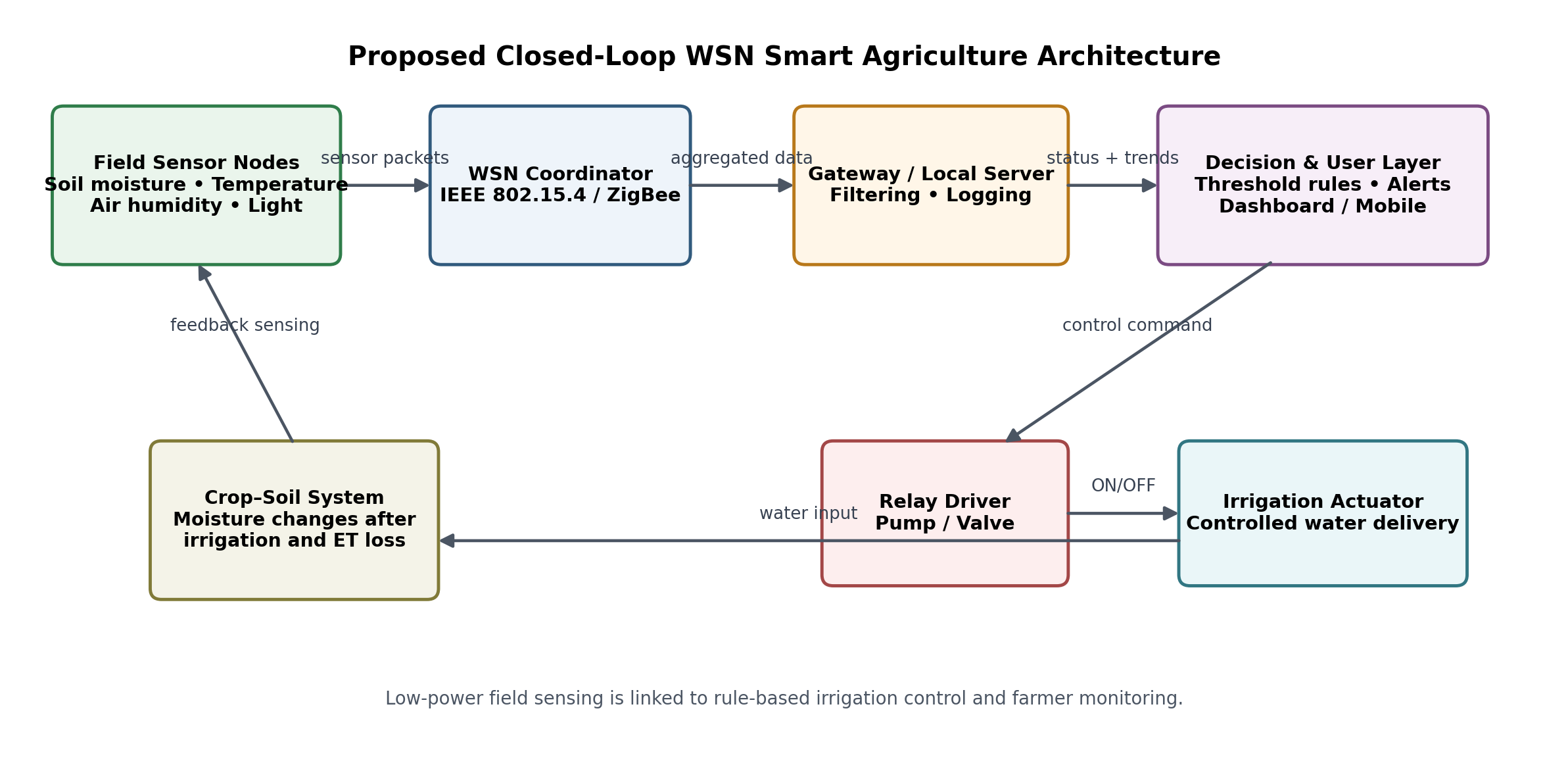
Agricultural production increasingly requires timely information on soil and microclimatic conditions while reducing water, labor, and energy use. This methodology paper proposes a wireless sensor network (WSN)-based smart agriculture monitoring and control system for small and medium farms. Distributed sensor nodes measure soil moisture, soil or ambient temperature, relative humidity, and light intensity; readings are transmitted through a low-power wireless network to a coordinator and gateway. A rule-based decision layer evaluates the measurements and automatically switches an irrigation pump or solenoid valve when soil moisture crosses crop-specific thresholds. The methodology combines hardware selection, node deployment, network communication, data validation, control logic, logging, and a simulation-based evaluation. Literature published up to 2018 is used to justify the architecture and design choices. In a three-day illustrative water-balance simulation, the threshold-driven controller required three irrigation events and 18 L of water compared with five scheduled events and 30 L in a fixed-time baseline, corresponding to a 40% reduction in applied water while maintaining the modeled soil-moisture threshold. The results are methodological and simulation-based rather than claims of field-trial performance. The proposed framework provides a reproducible basis for implementing and experimentally validating low-cost WSN-enabled precision irrigation and crop-environment monitoring.