Design and Implementation of a Smart Energy Meter Using GSM Technology
DOI:
https://doi.org/10.65521/ijeecs.v6i1.4494Keywords:
Abstract
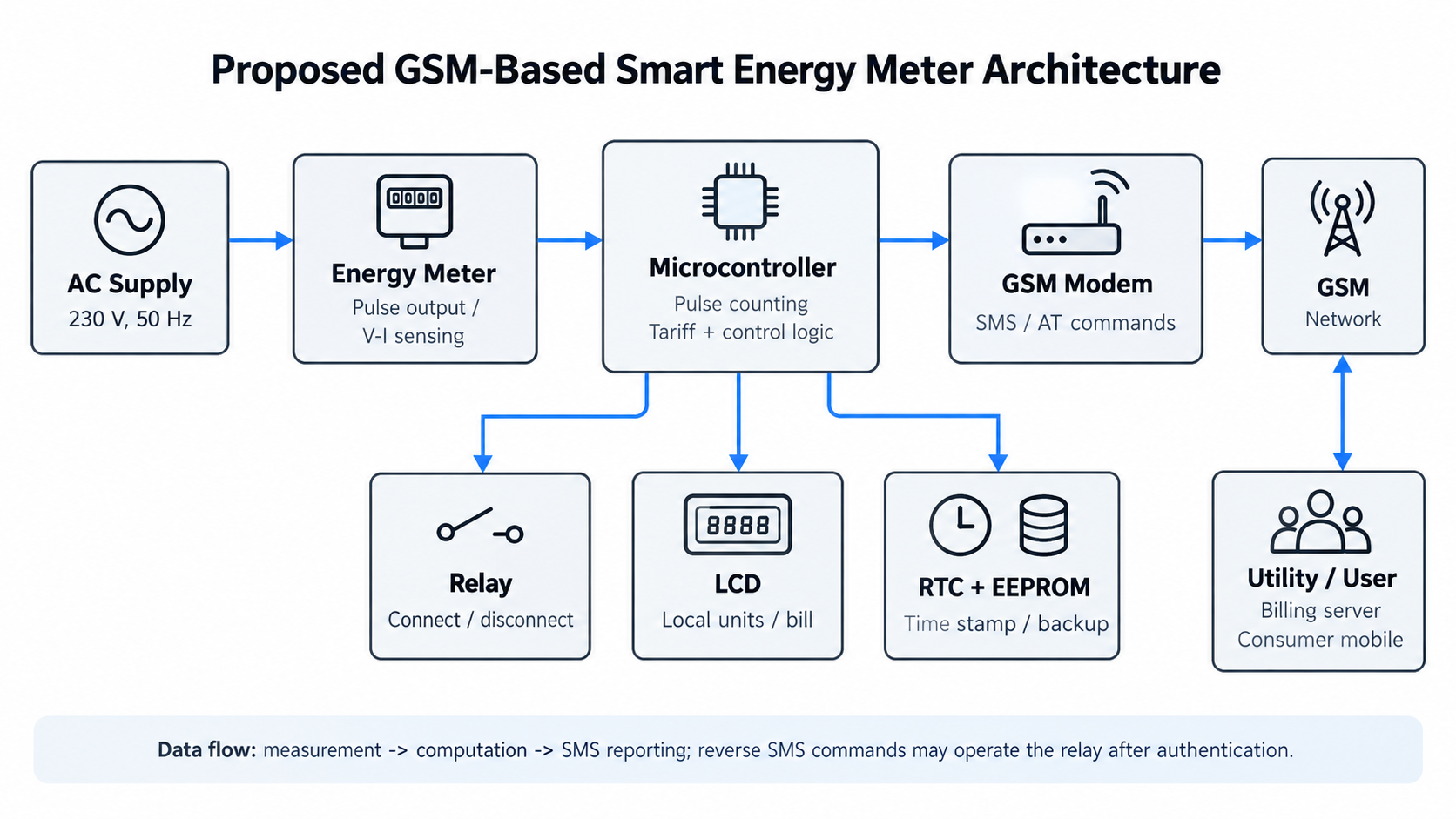
Conventional electricity metering depends on periodic manual reading and therefore introduces delays, transcription errors, labor cost, limited consumer feedback, and weak support for remote load management. This methodology paper presents the design of a low-cost smart energy meter that combines electronic energy measurement, a microcontroller, non-volatile storage, a liquid-crystal display, a relay, and Global System for Mobile Communications (GSM) technology. The proposed meter converts the energy-meter pulse output into accumulated kilowatt-hour consumption, calculates the payable amount according to a configurable tariff, displays local information, and transmits meter status and billing data through Short Message Service (SMS). Authorized SMS commands can also request a reading or connect/disconnect the load. The methodology is organized from requirements and hardware interfacing to firmware development, GSM communication, protection logic, and validation. A representative design-validation dataset shows how accuracy, SMS response, billing correctness, and relay control can be quantified; these values are illustrative and should be replaced by measured laboratory data when a physical prototype is constructed. The design follows the pre-2018 literature on GSM automatic meter reading, smart-meter communication, and remote billing, while emphasizing modularity, low infrastructure cost, and compatibility with existing cellular coverage.