Harmonic Compensation and Power Factor Enhancement Using a Three-Phase Shunt Active Power Filter
DOI:
https://doi.org/10.65521/ijeecs.v6i1.4489Keywords:
Abstract
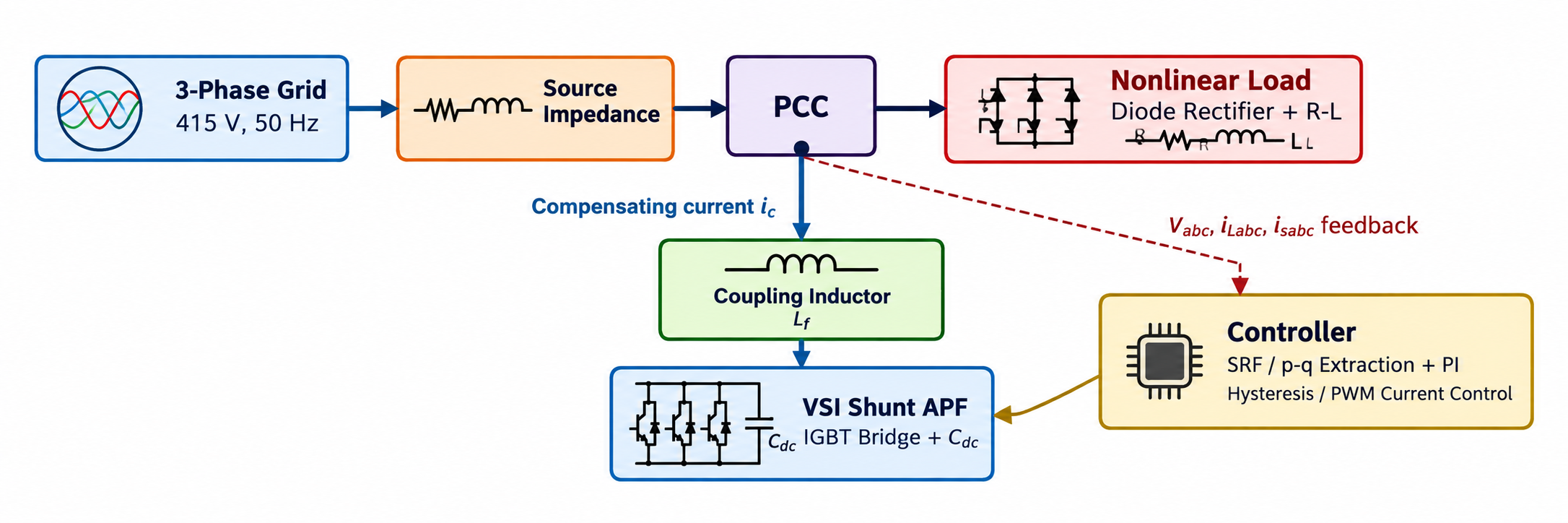
Nonlinear loads connected to three-phase distribution systems introduce harmonic currents, reactive-power demand, and poor power factor, which can degrade source-current quality and increase feeder losses. This study presents a simulation-oriented methodology for harmonic compensation and power-factor enhancement using a three-phase shunt active power filter. The proposed configuration employs a two-level voltage-source inverter connected at the point of common coupling through coupling inductors. Compensating-current references are generated using instantaneous-power or synchronous-reference-frame principles, while a proportional-integral controller regulates the DC-link voltage and hysteresis or PWM-based current control produces the inverter switching commands. The evaluation considers a representative six-pulse diode-rectifier nonlinear load and examines source-current waveform quality, total harmonic distortion, RMS current, low-order harmonic components, and true power factor before and after compensation. A reproducible harmonic-domain validation shows that source-current THD decreases from 38.16% to 2.80%, corresponding to a reduction of approximately 92.7%. The source-current RMS magnitude decreases from 21.41 A to 20.01 A, while true power factor improves from approximately 0.860 to 0.998. The fifth and seventh harmonic components are reduced by more than 90%, demonstrating the effectiveness of the compensation process. The methodology also considers DC-link stability, load variation, unbalanced operating conditions, and distorted supply voltage as important validation cases. The proposed framework provides a reproducible basis for MATLAB/Simulink or equivalent switching-system studies and for subsequent laboratory evaluation of active-filter control strategies.