Design and Implementation of a GSM-Based Automatic Energy Meter Reading System
DOI:
https://doi.org/10.65521/ijeecs.v4i1.4482Keywords:
Abstract
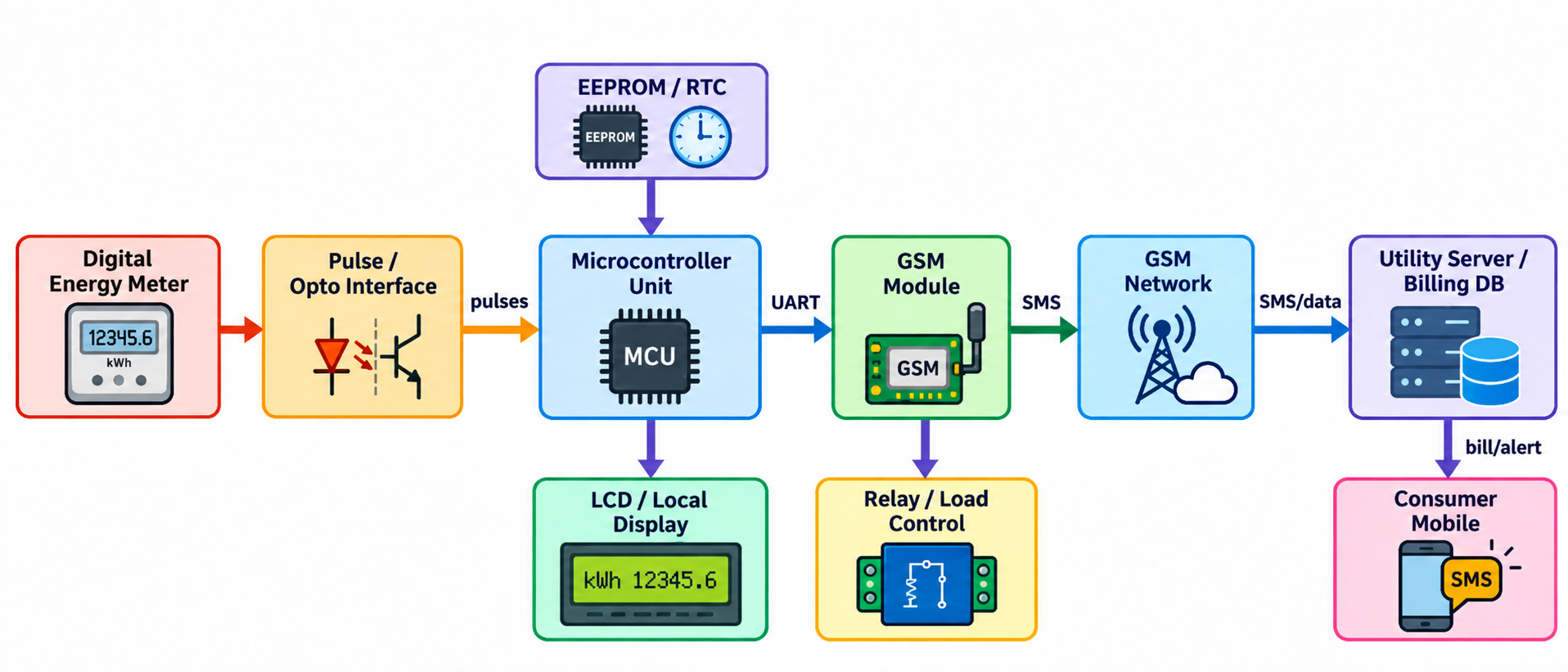
Conventional electricity-meter reading requires personnel to visit consumer premises, transcribe readings, and transfer the data to a billing system. The process is labor intensive, vulnerable to transcription errors, and unsuitable for frequent monitoring. This methodology paper presents the design and implementation framework for a GSM-based Automatic Energy Meter Reading (AEMR) system that acquires metering pulses, converts them into energy consumption, and transmits authenticated meter data to a utility-side billing database using Short Message Service (SMS). The proposed prototype integrates a digital energy meter, opto-isolated pulse interface, microcontroller, GSM modem, local display, non-volatile memory, and optional relay for remote load control. Its firmware counts calibrated meter pulses, timestamps readings, creates a compact SMS frame, manages acknowledgements and retransmissions, and preserves cumulative energy during power interruption. A utility-side receiver validates the meter identifier, stores readings, calculates consumption and billing, and returns bill or alert messages to the consumer. The design is informed by automated metering and smart-grid studies published through 2015, including SMS metering, GSM-enabled AMI, e-billing, and fault-tolerant GSM/GPRS schemes [1]-[10]. For methodological verification, the paper defines bench-test procedures for pulse accuracy, SMS delivery, latency, database integrity, power-failure recovery, and billing correctness. A reproducible design-stage simulation indicates that retry-based SMS handling can raise effective delivery reliability above the first-attempt rate while preserving meter continuity. The system is intended as a low-cost approach for utilities where GSM coverage is more available than dedicated metering networks.