AI-Based Energy Management for Grid-Isolated EV Charging in Smart Microgrid Systems
DOI:
https://doi.org/10.65521/ijeecs.v14i2.2894Keywords:
Abstract
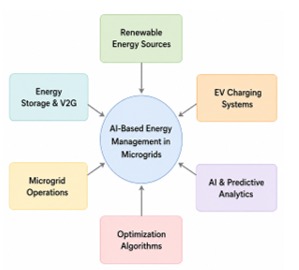
The increasing penetration of renewable energy sources and electric vehicles (EVs) has intensified the need for efficient energy management in microgrids, particularly in grid-isolated environments. Artificial intelligence (AI) has emerged as a powerful tool for optimizing energy consumption, enhancing system stability, and enabling real-time decision-making in complex energy systems. This paper presents a comprehensive survey of AI techniques for energy management in microgrids, with a special focus on hybrid human evolutionary optimization algorithms for grid-isolated EV charging systems. The integration of AI-based predictive models, optimization algorithms, and intelligent control strategies enables effective coordination between distributed energy resources, storage systems, and EV charging infrastructure. Recent advancements demonstrate that hybrid approaches combining evolutionary algorithms with machine learning and deep learning techniques outperform traditional optimization methods in terms of adaptability, scalability, and efficiency. This survey analyses 30 key studies and categorizes them based on methodologies such as optimization, machine learning, deep learning, and hybrid AI approaches. A comparative analysis highlights their advantages, limitations, and performance trends. The findings indicate that AI-driven microgrid energy management systems significantly improve operational efficiency, reduce energy costs, and enhance renewable energy utilization. However, challenges such as computational complexity, uncertainty in renewable generation, and lack of real-time deployment persist. Future research directions emphasize lightweight AI models, decentralized architectures, and integration with edge computing for real-time intelligent energy management in grid-isolated EV charging systems.