Child Labour and Economic Vulnerability: Examining the Intergenerational Cycle of Poverty in Developing Economies
Keywords:
Abstract
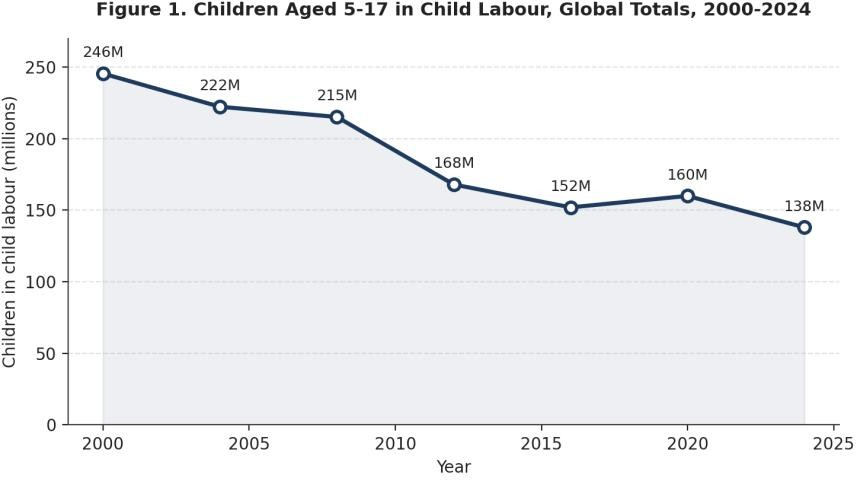
Child labour remains one of the most stubborn markers of economic deprivation in the developing world, and the relationship it holds with poverty is rarely one-directional. This paper sets out to examine how household economic vulnerability pushes children into work, and how that early labour, in turn, narrows the very opportunities that might have let a family climb out of poverty in the next generation. Drawing on ILO-UNICEF global estimates, World Bank poverty data, and a body of empirical literature spanning Latin America, Sub-Saharan Africa, and South Asia, the paper argues that child labour and poverty are locked in a mutually reinforcing loop rather than a simple cause-and-effect chain. The analysis shows that although the global number of children in child labour fell from roughly 246 million in 2000 to 138 million in 2024 (ILO & UNICEF, 2024), the burden has become increasingly concentrated in Sub-Saharan Africa, where population growth has outpaced the rate of decline. Household-level evidence from Brazil, Egypt, and Ethiopia indicates that children whose parents worked as children are themselves substantially more likely to enter the labour force early, which supports the existence of what economists have termed a child labour trap (Emerson & Souza, 2003; Basu & Van, 1998). The paper also reviews the record of policy interventions, particularly conditional cash transfer programmes, and finds that while they raise school enrolment fairly reliably, their effect on reducing child labour hours is considerably more mixed. The paper closes with a set of policy recommendations centred on social protection floors, agricultural productivity investment, and demand-side interventions in supply chains.