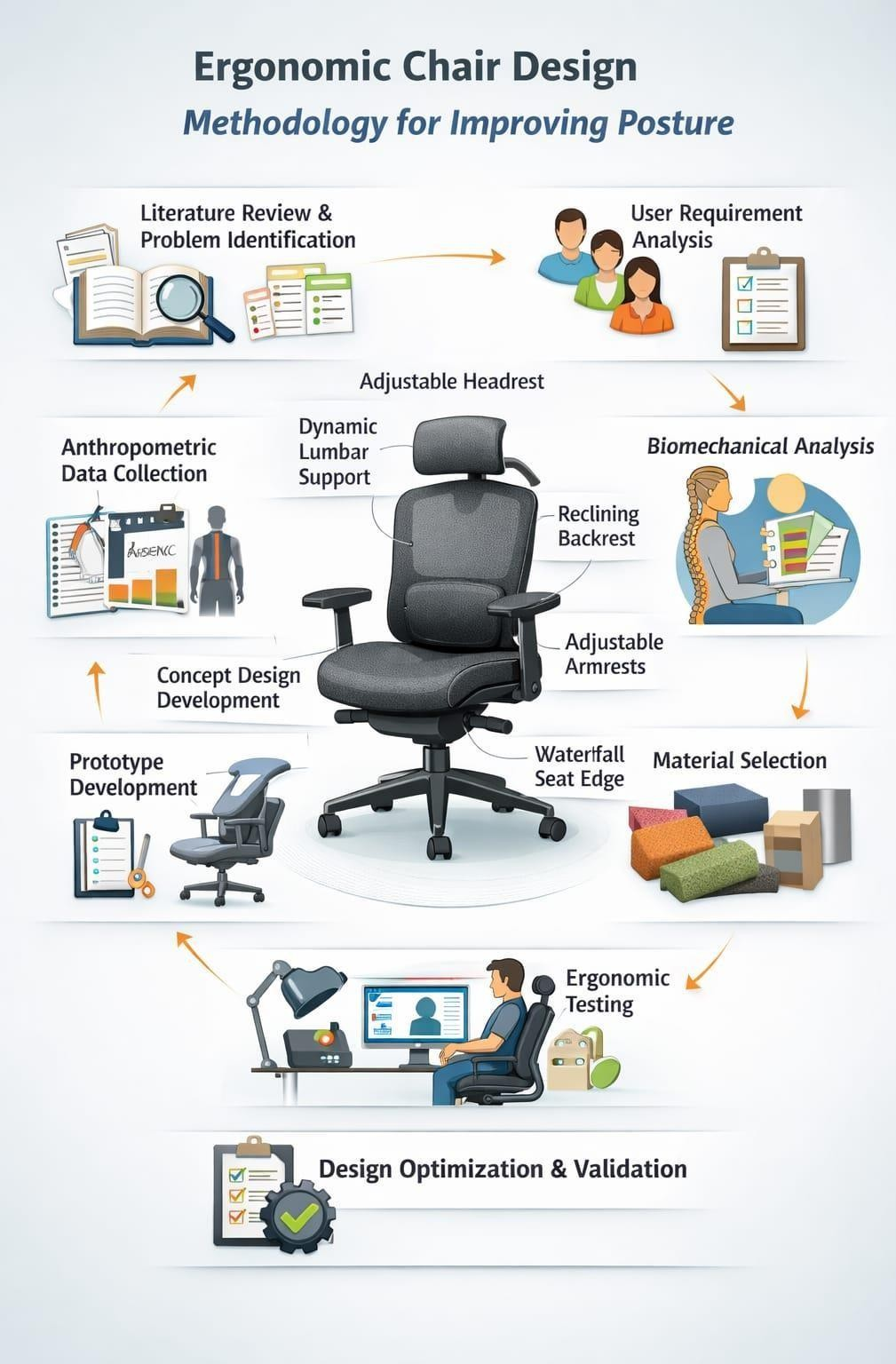
A Study on Egronomic Chair Desing for Improved Posture
Keywords:
Abstract
This paper presents a method for designing a customized ergonomic office chair backrest aimed at improving Ergonomic chairuser posture and long-term health. Given the importance of ergonomics in workplace settings, this study leCustom cushionverages 3D scanning and additive manufacturing to create personalized cushions that conform precisely to inAdditive manufacturingdividual anatomical shapes, aligning with ergonomic standards. The process begins with high- resolution scans of both the user’s back and a standard chair backrest, followed by cushion modeling in Blender to ensure exact fit and support. Additive manufacturing was selected for cushion fabrication, using a TPU material with an optimized internal structure to enhance comfort. Results indicate a notable improvement in posture alignment and comfort, verified through comparative scans before and after customization. The custom backrest encourages proper posture through a postural retraining effect and maintains hygiene through its nonporous material. Although the customization method is more suitable for individual users than shared work environments, it provides a practical and cost-effective solution for improving office seating ergonomics. This study also explores the feasibility of integrating Internet of Things (IoT) technology into office chair design to enhance user comfort and ergonomic support. Existing chair designs and IoT technologies were examined, followed by user testing of an IoT-enabled chair prototype. The System Usability Scale (SUS) was used to assess usability, while real-time feedback supported posture and comfort monitoring. Findings guided prototype improvements and demonstrated the potential of smart office furniture to improve workplace ergonomics, user satisfaction, and sitting comfort over extended periods for office workers. Twenty participants from a metropolitan university sat on two types of ergonomic chairs for 90 minutes in each of two sessions while performing typing, reading, and writing tasks. Repeated measures three-way and two-way analyses of variance were used to examine the effect of the ergonomic chair design on rating of discomfort. Data were collected usingthe General Comfort Rating Scale (GCRS) and the Body Part Discomfort Rating Scale (BPDRS), which were administered at0, 30, 60, and 90 minute marks of each session. The results revealed: 1) discomfort was not related to the type of chair, 2) discomfort increased over time, 3) discomfort was influenced by the task performed while sitting, 4) discomfort level decreasedwhen switching between different chairs, and 5) most discomfort was reported in the low back and lower arms.