Experimental Study on Mechanical Strength and Durability of Fiber-Reinforced Geopolymer Concrete with Mineral Admixtures
Keywords:
Abstract
All construction projects use concrete as a common building material. Building large, high-end, and sophisticated structures requires large amounts of cement. The demand for structural concrete depends on workability, strength, durability, in operation, portability, ease of working etc. Concrete technology has made many advances over the years. Significant advances in concrete technology include fiber-reinforced concrete (FRC), high-strength concrete, high-performance concrete, large-volume fly ash concrete, self- hardening concrete, self-compacting concrete, geopolymer concrete, etc., with consistent use of chemical and mineral admixtures The thesis begins with a blended design of GPC grade M-Forty. The mixture was modified using various amounts of ground granulated blast furnace slag (GGBS as replacements for fly ash.
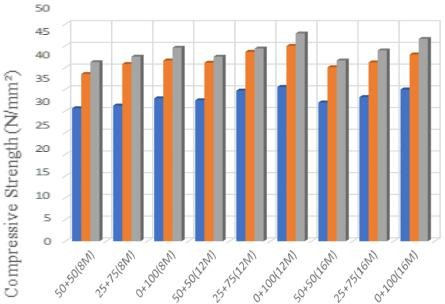
Like ordinary concrete, GPC has a denser structure, making compression more robust. The current study tested four types of fibers, metallic (steel fibers) and non-metallic (glass, polypropylene, basalt), in GPC mixes. Steel fibers are used at an optimum ratio of one with a maximum aspect ratio of forty. Non-metallic fibers such as glass, polypropylene, and basalt have been found to contribute little to increased strength.