
Machine Learning-Based Transcriptomic Profiling for Prognostic Risk Stratification in Clear Cell Renal Cell Carcinoma
Keywords:
Abstract
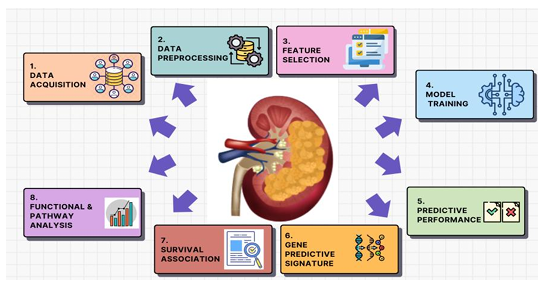
Clear cell renal cell carcinoma (ccRCC) is a molecularly heterogeneous malignancy, making survival-associated molecular patterns difficult to characterize.This study aimed to develop a machine learning-based gene signature for predicting 5-year survival in patients with ccRCC. TCGA-KIRC transcriptomic and clinical data was preprocessed, then underwent univariate feature selection, and finally classification using Logistic Regression. Both independent test set and internal five-fold cross validation were utilized to evaluate the performance of the model. The top 20 genes according to the regression coefficient with the greatest magnitude were used to build the predictive signature.The correlations of signature-derived risk scores with overall survival were assessed by Kaplan–Meier analysis. Functional interpretations were carried out by using Gene Ontology and KEGG pathway enrichment analysis. The resulting 20-gene signature performed well in predicting 5-year survival and showed good survival stratification. To identify the biological process and pathways linked to the signature genes, they were used in enrichment analysis. Overall, this study provides a machine learning-based molecular signature that may be useful for the prognostic risk stratification of ccRCC.
Downloads
Published
How to Cite
Issue
Section
License

This work is licensed under a Creative Commons Attribution-NoDerivatives 4.0 International License.
