Fruit Disease Detection
Keywords:
Abstract
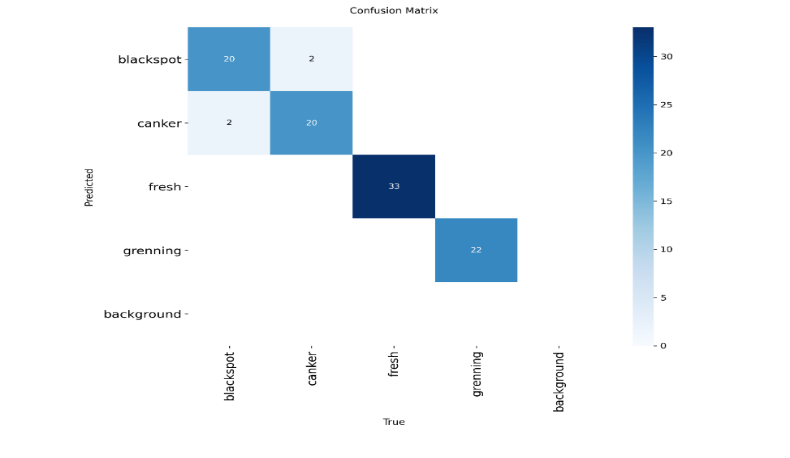
This paper shows a comparative study for automated detection & classification of diseases in orange fruits by traditional image-processing techniques & modern machine-learning techniques. We have used a dataset of 1,093 images having four classes namely, Black Spot, Canker, Greening, & Fresh, which was obtained from Kaggle website. The pipeline has image acquisition, preprocessing (resizing, filtering, contrast enhancement), segmentation (K-Means, thresholding, watershed), feature extraction (color statistics in RGB/HSV, texture descriptors from GLCM, & shape metrics), and classification using Support Vector Machine (SVM), Random Forest (RF), & K-Nearest Neighbors (KNN). 80% of the data was used for training & the rest 20% was used for testing the system, while the precision, accuracy, recall & F1-score were used to measure the performance of the system. The analysis showed us the advantages & limitations of both the techniques, however there were several drawbacks to classical models like the need for a static image, changes in light & background and limited size of dataset. The authors provide future directions for researchers working in this field, which include the development of real-time deep-learning detectors (i.e., YOLOv8), the use of edge devices & additional datasets that will allow simultaneous detection of multiple fruits in one go. This research is a collective effort of all the authors as it lays the foundation for precision agriculture.