Text-To-Visual Cryptographic Sharing: A Lightweight Framework For Secure Agent Communication
Keywords:
Abstract
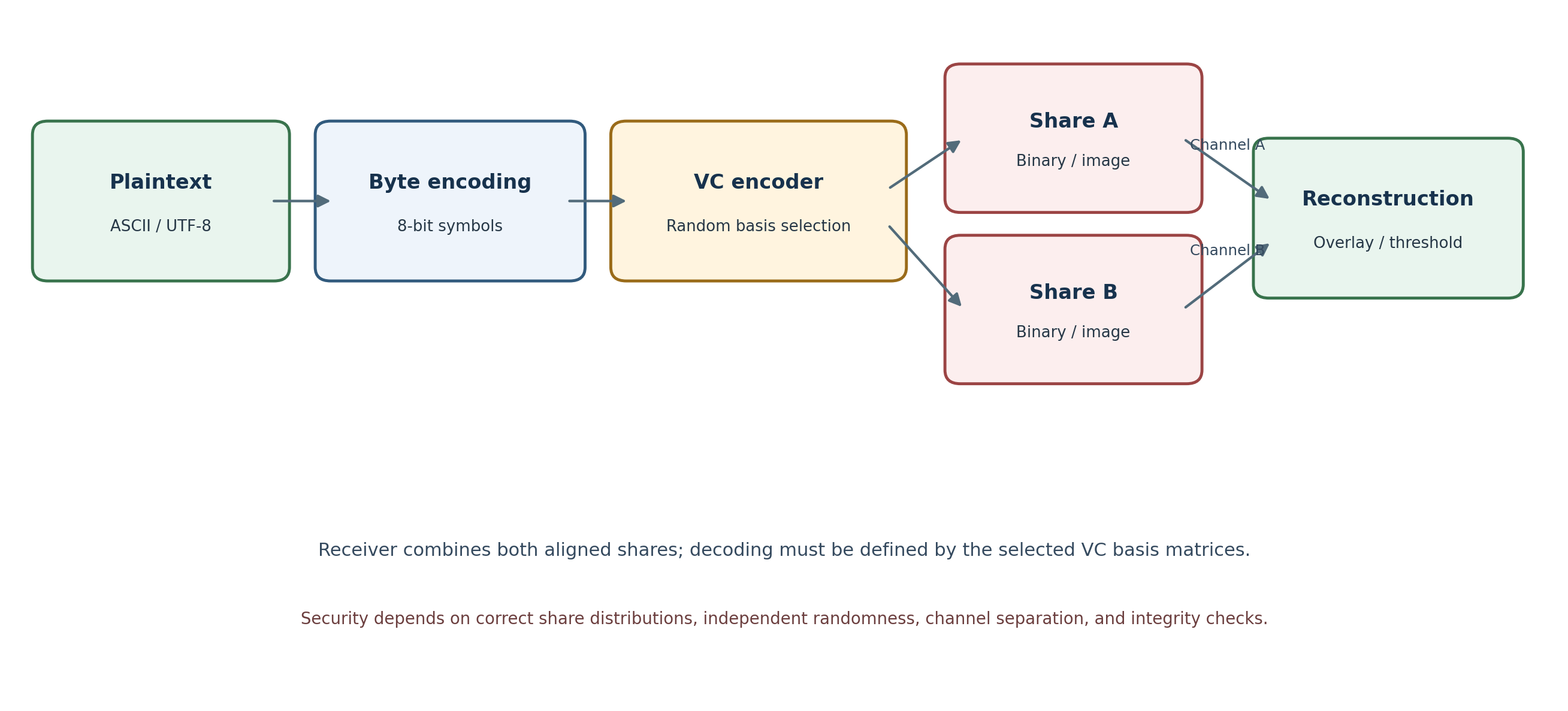
Secure communication in constrained and intermittently connected environments requires more than confidentiality: message size, key distribution, device energy, channel availability, integrity, and the detectability of communication also influence operational suitability. Visual cryptography (VC) offers a threshold secret-sharing approach in which a secret visual pattern is distributed among shares and reconstructed when an authorized subset is combined. This paper examines a text-to-visual-share (T2VS) workflow derived from a dissertation prototype that converts short ASCII messages into binary sequences, expands bits into subpixel patterns, distributes two shares, and reconstructs the message through a deterministic combining operation. The source dissertation reports a synthetic corpus of 500 messages, exact reconstruction for all test cases, and mean encoding times of 0.11 ms, 0.36 ms, and 0.72 ms for 30-, 100-, and 200-character messages, respectively. These figures are presented as source-reported prototype results, not as independently replicated measurements. A critical review identifies a fundamental security issue in the deterministic encoding rule used by the prototype: encoding a zero bit as [0,0] and a one bit as either [1,0] or [0,1] makes the distribution of an individual share depend on the secret bit. Consequently, the stated rule does not provide perfect secrecy for a single share, and its share patterns are statistically distinguishable. The paper therefore separates the reproduced baseline from a corrected research direction based on standard visual-secret-sharing basis matrices, in which each participant's marginal share distribution is independent of the secret and reconstruction is based on contrast/threshold decoding rather than a simplistic OR-to-bit mapping. The manuscript develops the system model, threat model, encoding and decoding workflow, evaluation methodology, limitations, and future research agenda. It argues that T2VS should be treated as a specialized secret-sharing layer—not a replacement for authenticated encryption—and recommends combining it with integrity protection, error correction, careful channel separation, and reproducible security testing.