A Survey of Methods and Architectures for Hybrid Transformer based Gated Graph Attention Capsule Network Design for Preventing Attack in Radar Target Detection
DOI:
https://doi.org/10.65521/ijacte.v12i2.3828Keywords:
Abstract
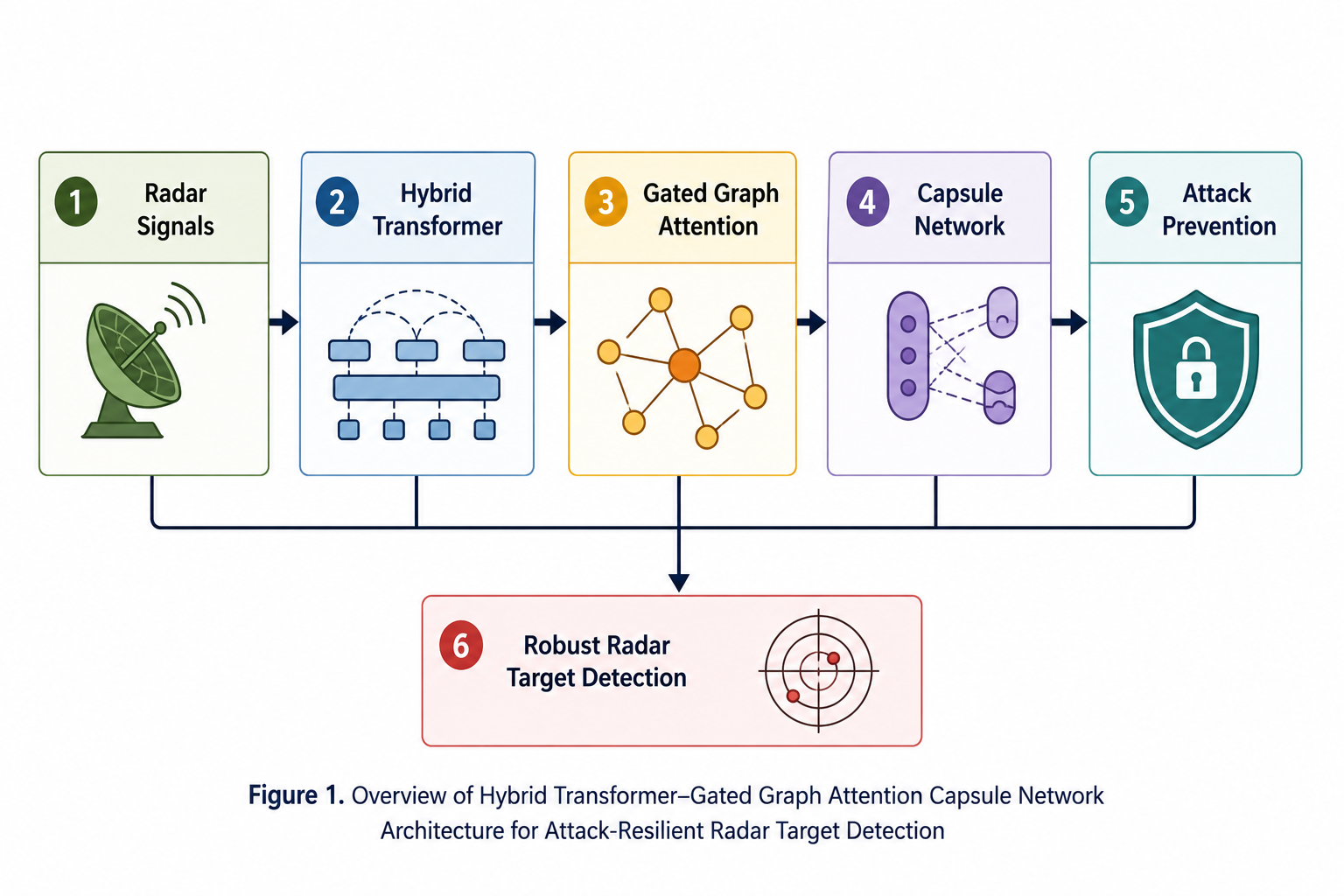
Radar target detection systems are fundamental to modern defence, surveillance, and autonomous navigation applications. However, these systems are increasingly exposed to adversarial threats such as jamming, spoofing, and signal manipulation, which can significantly degrade detection accuracy and reliability. Traditional signal processing methods are often inadequate in handling complex and dynamic attack scenarios, necessitating the integration of advanced artificial intelligence (AI) techniques. This survey explores recent methods and architectures based on hybrid Transformer-based gated graph attention capsule networks (TGACN) for enhancing robustness and security in radar target detection systems. The integration of Transformer models, graph attention networks (GAT), and capsule networks provides a powerful framework for capturing global dependencies, relational structures, and hierarchical feature representations. Transformers enable long-range contextual modelling, graph attention mechanisms capture inter-target relationships, and capsule networks preserve spatial hierarchies, making them highly resistant to adversarial perturbations. Recent studies demonstrate that hybrid architectures significantly improve detection accuracy, robustness, and adaptability in complex environments. These models effectively mitigate issues such as low signal-to-noise ratio (SNR), interference, and adversarial attacks. However, challenges remain in terms of computational complexity, training requirements, and real-time implementation. This survey analyses recent research trends (2020–2023), highlighting key techniques, architectural innovations, and performance improvements. It also identifies open challenges and future research directions, including lightweight architectures, explainable AI, and edge-based deployment. The findings provide valuable insights into designing next-generation intelligent and secure radar detection systems.