Deep Learning and Optimization Approaches in Resource allocation via Sparsity-Aware Orthogonal Initialization of Deep Neural Networks in free space optical communications: A Review
DOI:
https://doi.org/10.65521/ijacte.v12i2.3827Keywords:
Abstract
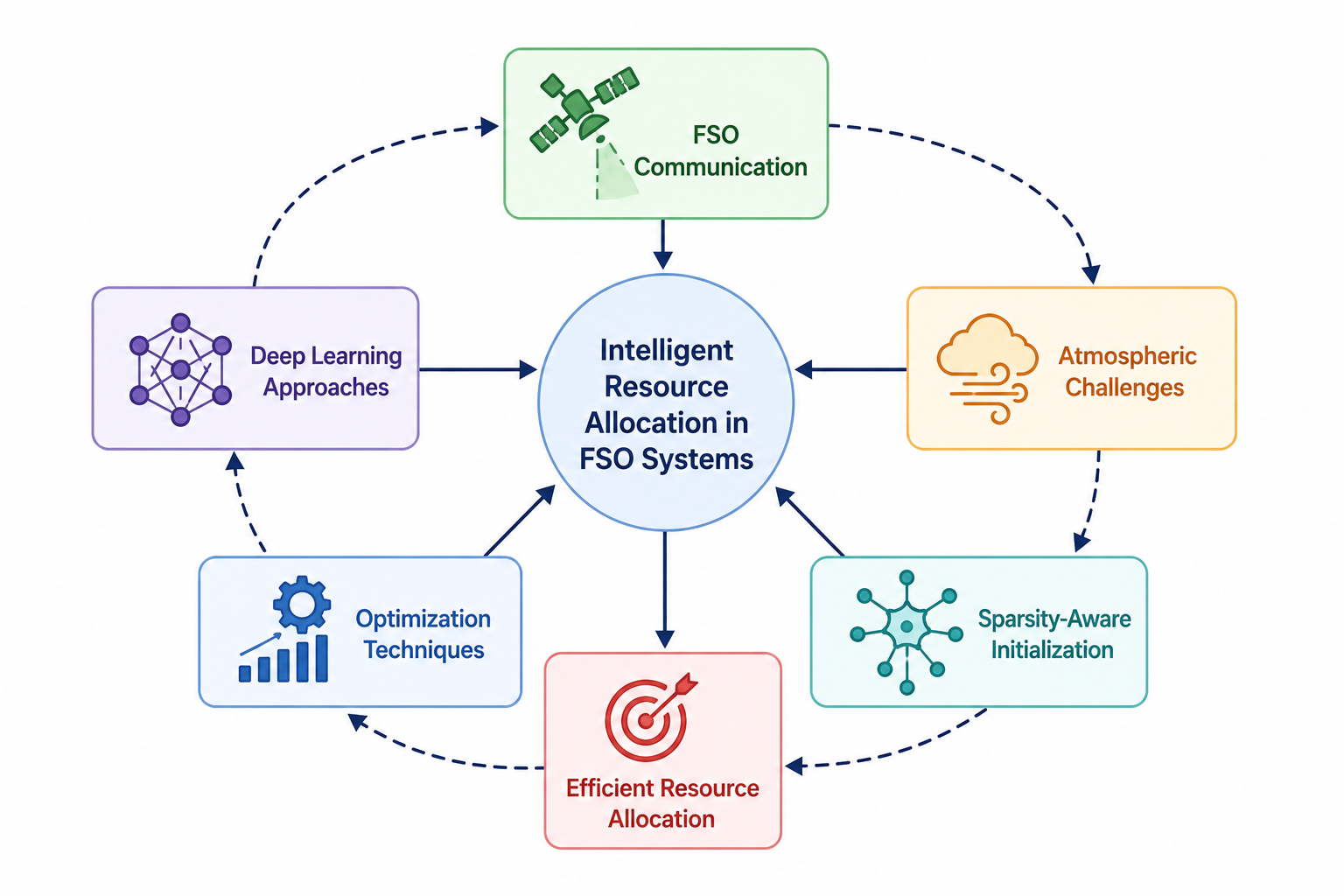
Deep learning and optimization techniques have emerged as transformative solutions for addressing complex resource allocation challenges in free-space optical (FSO) communication systems. FSO communication offers high data rates and low latency; however, its performance is significantly affected by atmospheric turbulence, channel fading, and dynamic environmental conditions. Traditional optimization approaches often rely on precise system models, which are difficult to obtain in real-world deployments. To overcome these limitations, recent research has focused on model-free deep learning frameworks that can learn optimal resource allocation policies directly from data. For instance, primal–dual deep learning methods have been shown to efficiently handle stochastic optimization problems related to power allocation and relay selection without requiring explicit channel models. In parallel, the development of sparsity-aware neural architectures has gained attention to address computational and energy constraints in communication systems. Sparsity-Aware Orthogonal Initialization (SAOI) introduces structured sparsity into neural networks while preserving dynamical isometry, enabling efficient training of very deep models with reduced computational overhead. This is particularly relevant for FSO systems where real-time processing and energy efficiency are critical. By integrating sparsity-aware initialization with deep learning-based optimization strategies, it is possible to design scalable and robust resource allocation frameworks. Furthermore, deep learning techniques such as convolutional neural networks (CNNs), graph neural networks (GNNs), and reinforcement learning have been successfully applied to optimize channel estimation, adaptive modulation, and resource management in optical communication networks. These approaches enable intelligent decision-making under uncertainty and improve system reliability in the presence of turbulence and noise.