Extraction and Phytochemical Analysis of Bioactive Compounds from Medicinal Plants for Pharmaceutical Applications
DOI:
https://doi.org/10.65521/ijacsa.v6i1.4367Keywords:
Abstract
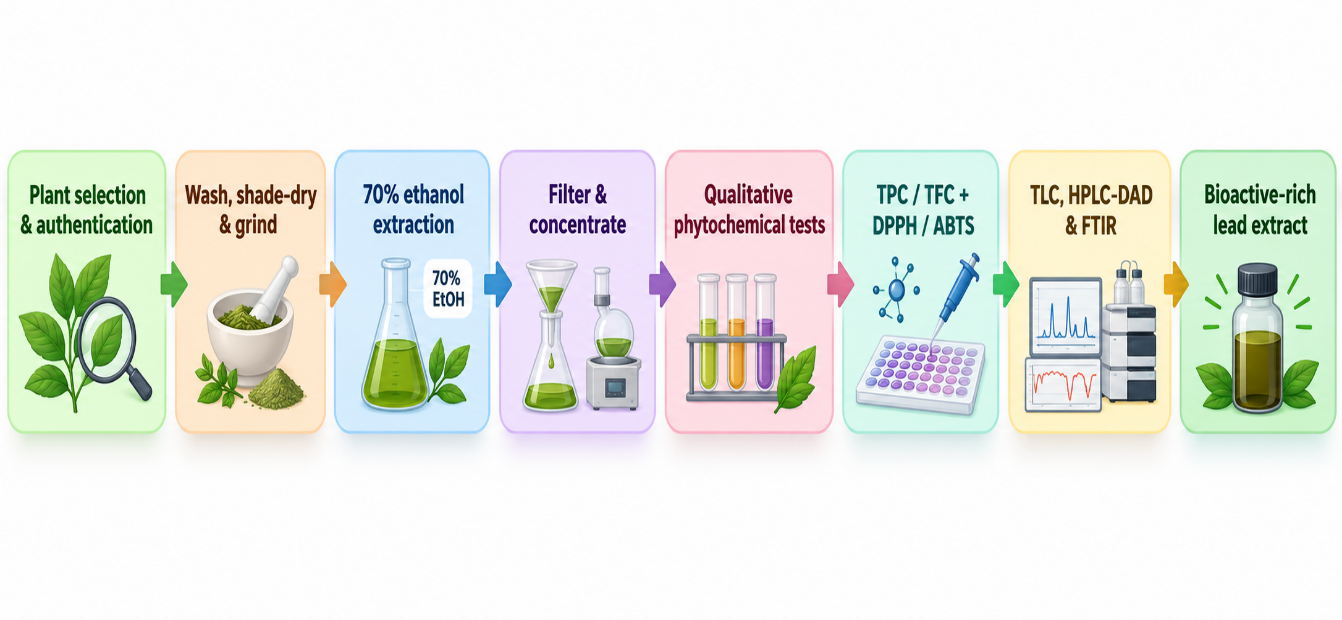
Medicinal plants remain important sources of chemically diverse molecules for drug discovery, standardized herbal products and pharmaceutical excipients. The present methodology establishes an integrated procedure for extracting and characterizing bioactive constituents from selected medicinal plants, with emphasis on reproducibility, solvent efficiency and analytical confirmation. Three representative medicinal plants—Azadirachta indica, Ocimum tenuiflorum and Moringa oleifera—are proposed as comparative matrices. Authenticated plant material is washed, shade-dried, milled and extracted with 70% ethanol using ultrasound-assisted extraction, while aqueous and absolute-ethanol extractions are retained as solvent controls. Crude extracts are concentrated under reduced pressure and evaluated by preliminary tests for alkaloids, phenolics, flavonoids, tannins, saponins and terpenoids. Total phenolic and flavonoid contents are quantified spectrophotometrically, antioxidant capacity is assessed by DPPH and ABTS assays, and chemical fingerprints are generated by thin-layer chromatography, HPLC-DAD and FTIR spectroscopy. Extraction yield, phytochemical content and antioxidant response are compared statistically to identify the most promising bioactive-rich extract for further pharmaceutical development. The illustrative validation dataset suggests that hydroethanolic extraction can provide a favorable compromise between mass yield, phenolic recovery and radical-scavenging activity. The proposed workflow links botanical authentication, extraction, screening, quantification and instrumental characterization in a single methodology suitable for subsequent formulation, bioactivity-guided fractionation and quality-control studies.