Kinetic Study and Process Optimization of Dye Degradation in Aqueous Solutions Using Advanced Oxidation Processes
DOI:
https://doi.org/10.65521/ijacsa.v6i1.4366Keywords:
Abstract
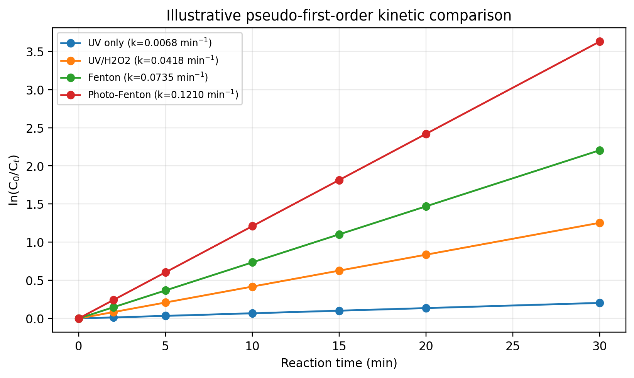
Advanced oxidation processes (AOPs) are effective for degrading persistent dye molecules because they generate highly reactive radical species, particularly hydroxyl radicals, that attack chromophoric groups and aromatic structures. This methodology paper proposes an integrated kinetic and statistical framework for degrading Methyl Orange (MO) in aqueous solution using UV irradiation, UV/H2O2, Fenton and photo-Fenton oxidation, followed by optimization of the most efficient system. The experimental design uses a central composite design within response surface methodology to quantify the effects of initial pH, ferrous-ion dosage and hydrogen-peroxide dosage while holding temperature, mixing and irradiation intensity constant. Dye concentration is monitored by UV-Vi’s spectrophotometry and mineralization is evaluated by chemical oxygen demand (COD). Kinetic data are examined using pseudo-first-order and pseudo-second-order expressions, and the optimized conditions are verified through confirmation experiments. An illustrative dataset, included only to demonstrate analysis and interpretation, indicates the expected superiority of photo-Fenton oxidation and the importance of acidic pH and balanced Fe2+/H2O2 doses. The proposed approach integrates kinetic constants, half-life, percentage decolorization, COD reduction, analysis of variance and response-surface optimization into a reproducible procedure suitable for laboratory studies of dye-containing wastewater.