Kinetics and Mechanistic Signatures in the Oxidation of α-Hydroxy Acids by PCC, PDC, QDC and TBAD: A Comprehensive Comparative Study
DOI:
https://doi.org/10.65521/ijacsa.v15i1.3187Keywords:
Abstract
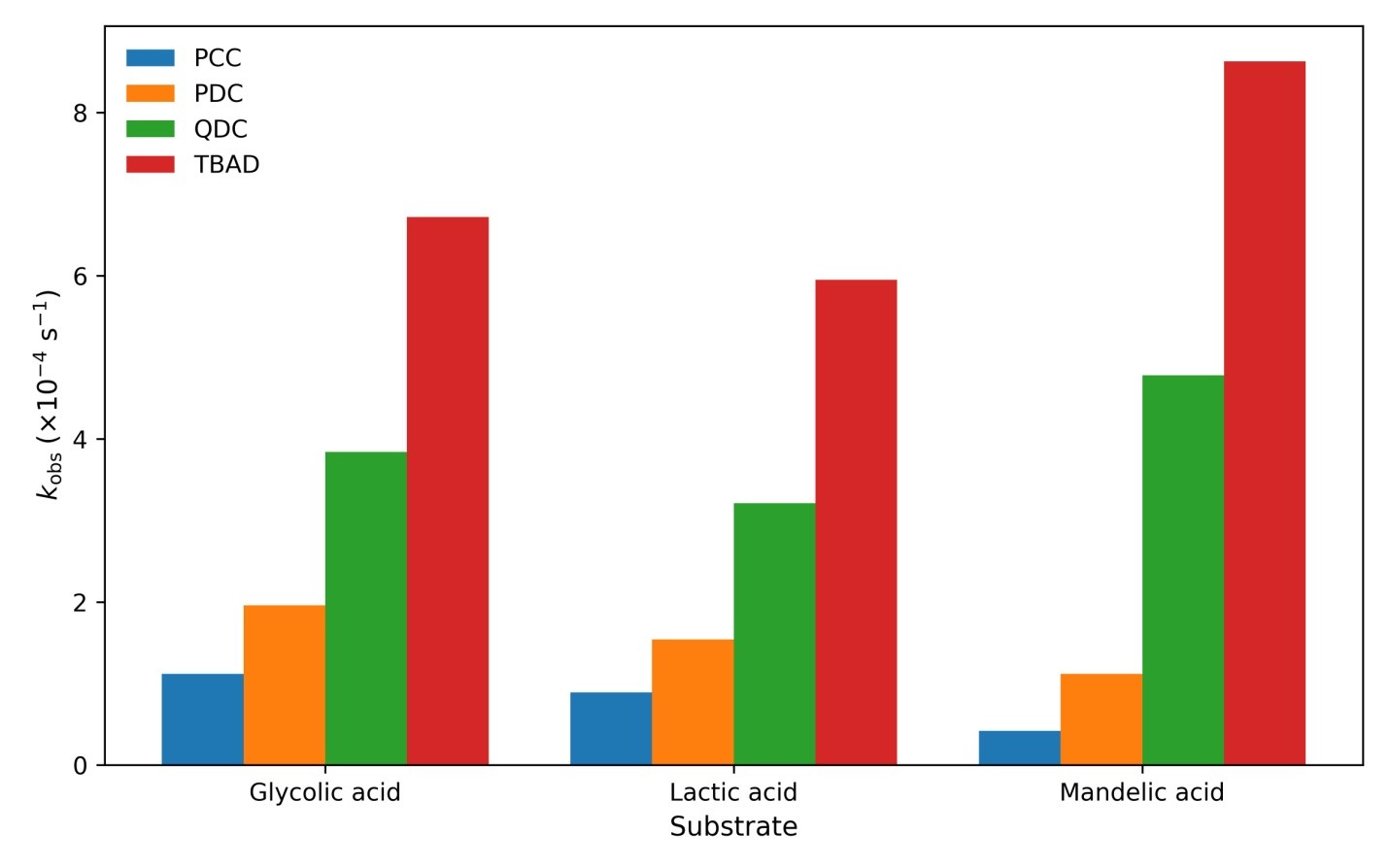
The oxidation of α-hydroxy acids by chromium(VI) provides a valuable system for differentiating weakly associated chromate-ester pathways from strongly organized cyclic inner-sphere mechanisms. A systematic kinetic comparison of glycolic, lactic, and mandelic acids with pyridinium chlorochromate (PCC), pyridinium dichromate (PDC), quinolinium dichromate (QDC), and tetrabutylammonium dichromate (TBAD) was performed under controlled acidic conditions. All systems obey pseudo–first-order kinetics with respect to chromium(VI). PCC and PDC exhibit linear substrate dependence, whereas QDC and TBAD display saturation kinetics consistent with reversible substrate–oxidant complex formation. Acid-dependence studies reveal near-first-order proton involvement for PCC (slope ≈ 1.0) and saturation behavior for QDC and TBAD. Activation entropies become progressively more negative across the oxidant series (PCC: –28 J mol⁻¹ K⁻¹; TBAD: –89 J mol⁻¹ K⁻¹), indicating increasing transition-state organization. The combined kinetic and thermodynamic parameters establish a consistent mechanistic ordering across the oxidant series governed by counterion lipophilicity and solvation effects.