Hardware-Efficient CNN Design Using Approximate Multipliers and Adders for MNIST Classification
DOI:
https://doi.org/10.65521/mjret.v12i2.2790Keywords:
Abstract
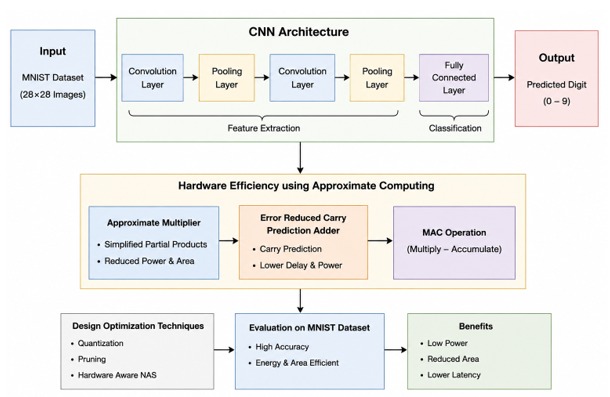
The increasing demand for energy-efficient deep learning systems has driven significant research in hardware optimization of Convolutional Neural Networks (CNNs). CNNs require intensive multiply–accumulate (MAC) operations, which contribute to high power consumption and hardware complexity. To address these challenges, approximate computing techniques such as decoder-based low-power approximate multipliers and error-reduced carry prediction adders have been widely explored. This survey reviews recent methods and architecturesfor improving CNN hardware efficiency, particularly for MNIST dataset classification. Approximate multipliers reduce partial product generation complexity and power consumption, while approximate adders minimize delay and hardware overhead through simplified carry propagation. Studies show that approximate CNN accelerators can reduce energy consumption by up to 30–80% with minimal accuracy loss . Additionally, hardware-aware optimization techniques, including quantization and neural architecture search, further enhance performance. The integration of approximate arithmetic into CNN accelerators significantly improves throughput, area efficiency, and energy consumption. However, challenges such as accuracy degradation, scalability, and design complexity remain. This survey provides a comparative analysis of existing techniques and highlights future research directions for developing efficient CNN hardware architectures.