
Why Construction-Friendly OSP Designs Are More Valuable Than Perfect Designs
DOI:
https://doi.org/10.65521/mjret.v13i1.1865Keywords:
Abstract
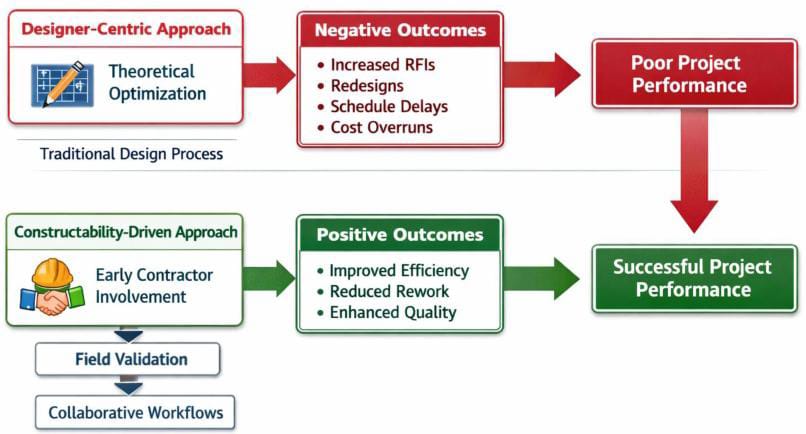
Background: Background: Common challenges in the implementation of Background: Outside Plant (OSP) infrastructure projects are cost overruns, schedule slippage and excess Requests for Information (RFIs) because of poor fit in an ideal design and reality of construction. Practice in traditional OSP design focuses on technical perfection; minimization of signal loss, optimum routing algorithms, and rigor to regulatory compliance, without much attention to practical construction reality like site accessibility, utility conflicts, workforce safety and permitting complexities. The lack of congruence between designer wishes and the ability of constructors creates a high level of inefficiency in projects.
Purpose: The paper will assess the reasons why construction friendly OSP designs offer a superior project value over theoretically optimal designs by evaluating the differences in cognition of the designer and the constructor mindsets, discussing the root causes of a RFIs and redesigns, and generalizing the evidence of project outcomes in the real-world demonstrating performance difference between an optimization-oriented and constructability-oriented approach.
Methods: A qualitative systematic review of 30 peer-reviewed papers (1964-2025) was carried out, and the thematic analysis method was used to find patterns in designer-constructor attitudes, factors of RFI causation, project delivery model, and performance impacts. Evidence of telecommunications infrastructure projects was integrated in order to build relationship between design strategies and their implementation success.
Results: It can be determined that underlying cognitive mismatch exists: designers make optimal decisions based on idealized assumptions of technical performance, whereas constructors make optimal decisions based on actual variability of the world of building. Three main drivers of RFI can be identified, namely utility clashes (53% of studies), permit conflicts (40%), and site access issues (47%), and they are all due to the insufficient field validation in design. Construction friendly designs with the use of early contractor involvement and field substantiated assumptions show consistent increase in schedule adherence, controlling costs and safety performance in the documented case implementations.
Contribution: The study provides a constructability-based model of OSP design practice, showing that implementability offers more project value than theoretical optimisation, and practical strategies on how construction knowledge is to be incorporated into design processes.
Downloads
Published
How to Cite
Issue
Section
License

This work is licensed under a Creative Commons Attribution-NoDerivatives 4.0 International License.
