A Comprehensive Review of Design of Reconfigurable Low Noise Amplifier Using Hybrid Forensic-Based Investigation Algorithm and Human Urbanization Algorithm for EEG Classification
DOI:
https://doi.org/10.65521/itsi-teee.v14i2.2829Keywords:
Abstract
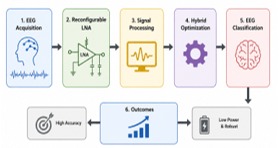
Electroencephalography (EEG)-based classification systems have gained significant importance in biomedical signal processing, particularly in brain–computer interface (BCI) applications and neurological disorder detection. However, EEG signals are highly susceptible to noise, low amplitude, and environmental interference, making signal acquisition and processing challenging. Low Noise Amplifiers (LNAs) play a critical role in improving signal quality by amplifying weak EEG signals while minimizing noise. This paper presents a comprehensive review of reconfigurable LNA design integrated with hybrid optimization techniques, including forensic-based investigation algorithms and human urbanization algorithms, for enhanced EEG classification performance. Recent studies show that optimization algorithms significantly improve feature selection and classification accuracy in EEG systems by reducing redundant data and enhancing signal quality. Additionally, noise-robust learning algorithms and preprocessing techniques further improve classification accuracy and reliability. Hybrid optimization approaches demonstrate superior performance compared to conventional methods, achieving higher classification accuracy and improved robustness. This review analyses recent developments, compares various optimization techniques, and highlights challenges such as hardware complexity, noise sensitivity, and scalability. The findings indicate that integrating reconfigurable LNAs with advanced optimization algorithms provides a promising solution for efficient and accurate EEG classification systems.