
A Comprehensive Review of Identification of Alzheimer’s Disease from Central Lobe EEG Signals Utilizing Dynamic Path-Controllable Deep Unfolding Network and Residual Attention Neural Network
DOI:
https://doi.org/10.65521/intjournalrecadvengtech.v14i1.2569Keywords:
Abstract
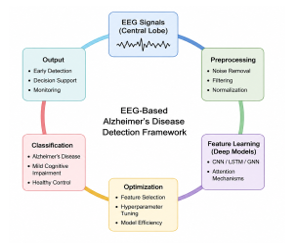
Alzheimer’s Disease (AD) is a progressive neurodegenerative disorder characterized by cognitive decline and memory impairment. Early detection remains a critical challenge due to subtle neurological changes in the initial stages. Electroencephalography (EEG) has emerged as a promising non-invasive technique for detecting AD by capturing abnormal brain activity patterns. Recent advances in deep learning have significantly improved the automated classification of EEG signals, enabling early and accurate diagnosis. Convolutional Neural Networks (CNN), Recurrent Neural Networks (RNN), Graph Neural Networks (GNN), and attention-based models have demonstrated strong performance in capturing spatial-temporal EEG features. In particular, deep pyramid CNN models have shown effectiveness in classifying EEG signals for AD detection. Furthermore, computational EEG analysis methods such as wavele t-based and entropy-based techniques have proven effective in distinguishing AD patients from healthy individuals. Emerging approaches such as graph-based neural networks and transformer architectures further enhance classification accuracy by modelling brain connectivity and long-range dependencies. Despite these advancements, challenges such as data scarcity, model interpretability, and computational complexity persist. This review provides a comprehensive analysis of deep learning and optimization approaches for AD detection using central lobe EEG signals and highlights the potential of dynamic path-controllable deep unfolding networks and residual attention neural networks for improved diagnosis.
Downloads
Downloads
Published
How to Cite
Issue
Section
License

This work is licensed under a Creative Commons Attribution-NoDerivatives 4.0 International License.
