IoT-Driven Smart Grid Monitoring with Renewable Energy and EV Integration Using HCNN: A Review
Keywords:
Abstract
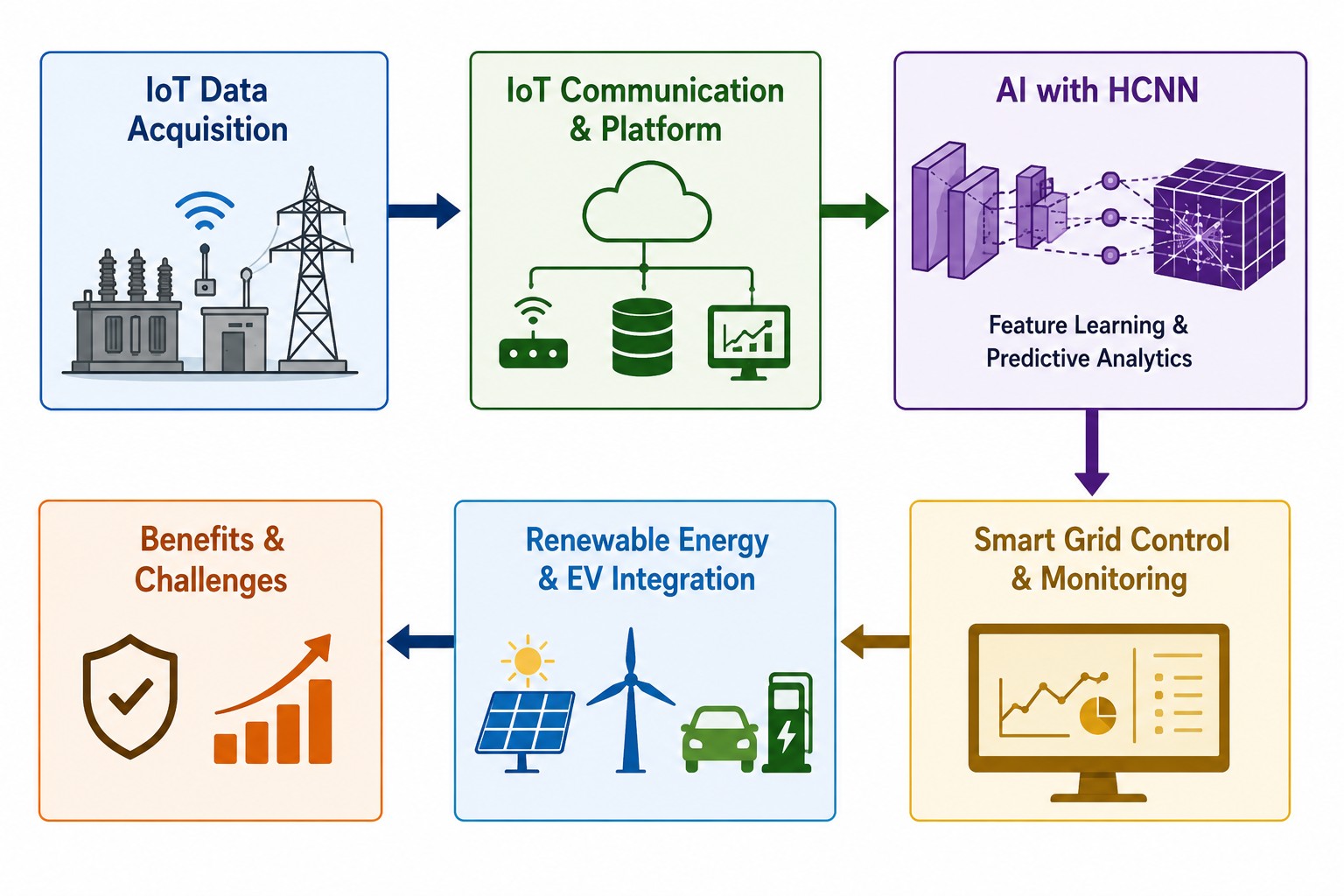
The evolution of smart grids and digital substations has significantly transformed modern power systems by enabling real-time monitoring, intelligent control, and efficient energy management. The integration of Internet of Things (IoT) technologies into substations and smart grids facilitates continuous data acquisition from distributed sensors, enhancing system visibility and operational efficiency. However, challenges such as load variability, renewable energy intermittency, energy management complexity, and cyber-physical security remain critical concerns. Recent advancements in deep learning, particularly Convolutional Neural Networks (CNNs) and emerging holographic convolutional neural networks (HCNNs), have demonstrated strong capabilities in handling high-dimensional grid data, enabling predictive analytics, fault detection, and energy optimization. IoT-enabled smart grids allow real-time monitoring and control of power parameters, improving load management and reducing energy losses. Additionally, deep learning models enhance grid stability, demand forecasting, and cyber-physical system security in modern power systems. The integration of renewable energy sources (solar, wind) and electric vehicles (EVs) introduces additional complexity due to fluctuating generation and dynamic load demand. IoT-driven systems combined with intelligent algorithms enable adaptive energy distribution and demand-response mechanisms, improving grid resilience and sustainability. This review presents a comprehensive analysis of IoT-driven control and monitoring systems for substations and smart grids, focusing on deep learning approaches, including holographic CNNs, renewable energy integration, and EV-based load management. It highlights recent advancements, comparative methodologies, challenges, and future research directions.