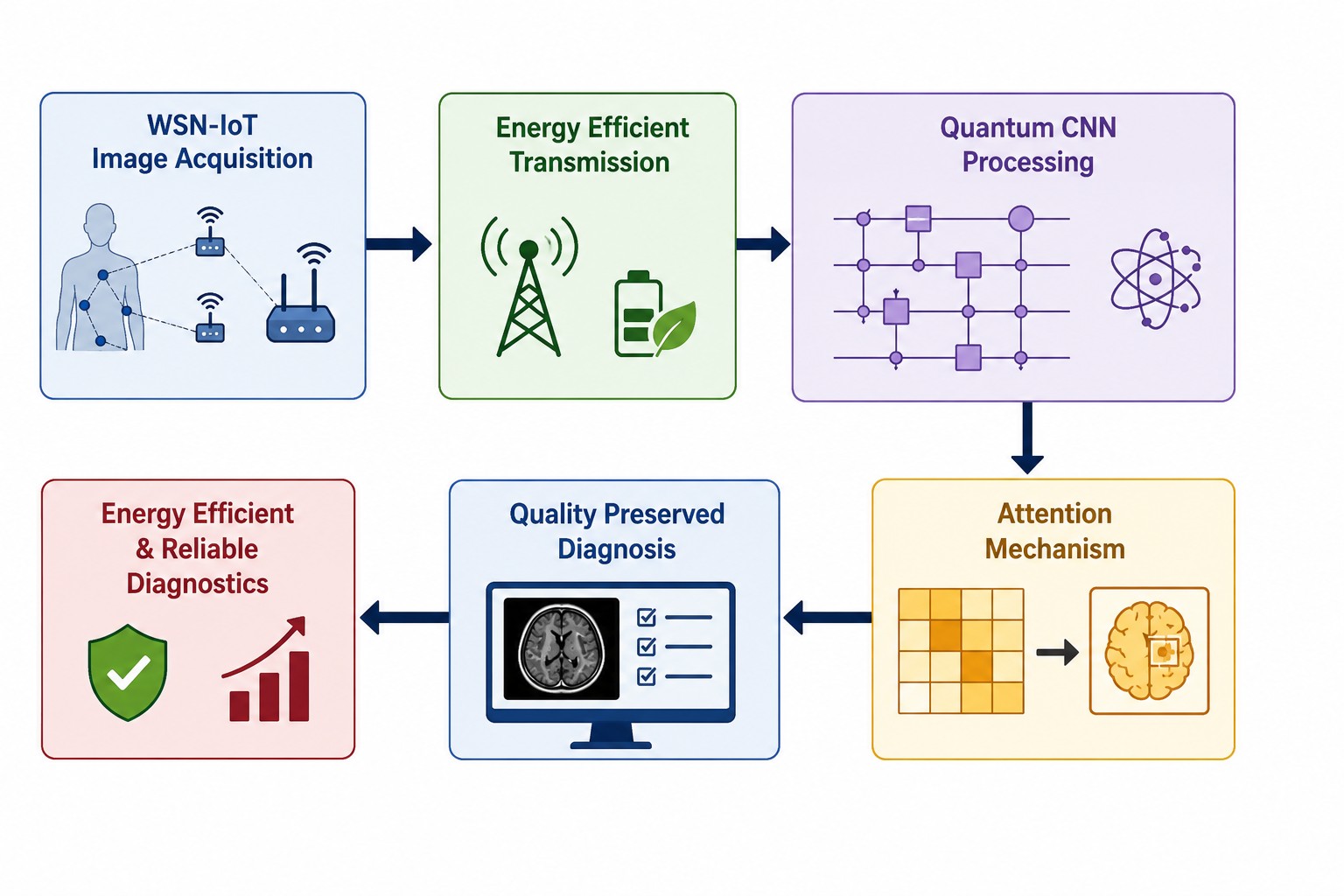
A Survey of Methods and Architectures for Energy Efficient Quantum Convolutional Neural Networks with Attention-Based Models for Quality Preservation in WSN assisted IoT Medical Image Diagnostics
Keywords:
Abstract
Wireless Sensor Network (WSN)-assisted Internet of Things (IoT) systems have revolutionized modern healthcare by enabling real-time medical image acquisition, transmission, and remote diagnostics. However, these systems face critical challenges such as limited energy resources, bandwidth constraints, and degradation of image quality during transmission and processing. Ensuring energy-efficient computation while preserving diagnostic image quality is therefore essential for reliable medical decision-making. Artificial Intelligence (AI)-driven approaches, particularly Quantum Convolutional Neural Networks (QCNNs) integrated with attention-based models, have emerged as promising solutions to address these challenges. Quantum Convolutional Neural Networks leverage principles of quantum computing such as superposition and entanglement to process high-dimensional data more efficiently than classical convolutional neural networks. QCNN architectures can significantly reduce model parameters and computational complexity while maintaining high accuracy, making them suitable for resource-constrained WSN environments. Studies indicate that QCNNs can outperform classical CNNs in terms of efficiency and scalability, especially in complex image classification tasks. Additionally, hybrid quantum-classical models further enhance performance by combining classical feature extraction with quantum optimization capabilities. Attention-based models play a vital role in improving medical image diagnostics by focusing on relevant regions of interest and suppressing noise. Deep learning techniques, particularly CNN-based models, have demonstrated superior performance in medical image understanding tasks such as classification, segmentation, and detection. Attention mechanisms enhance these capabilities by improving feature representation and preserving critical diagnostic information, thereby improving overall image quality.