Recent Advances in Dual-Stage Interleaved Onboard Charger with PIDD2-PD Controller and Hybrid Adaptive Genghis Khan Shark Gold Rush for Electric Vehicles: A Systematic Review
Keywords:
Abstract
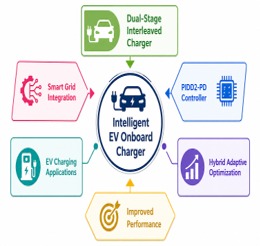
The rapid electrification of transportation has accelerated the development of efficient and intelligent onboard charging systems for electric vehicles (EVs). Dual-stage interleaved onboard chargers have gained prominence due to their high power density, reduced current ripple, and improved efficiency. However, conventional control methods face challenges such as instability, slow transient response, and limited adaptability under nonlinear operating conditions. This review focuses on advanced control and optimization techniques for dual-stage interleaved onboard chargers, emphasizing the integration of the PIDD2-PD controller with hybrid adaptive optimization frameworks. The PIDD2-PD controller enhances system stability, improves disturbance rejection, and enables faster convergence under dynamic conditions. To further optimize performance, hybrid metaheuristic algorithms such as the Genghis Khan Shark Gold Rush approach are explored for real-time parameter tuning and multi-objective optimization. The study examines applications across grid-to-vehicle, vehicle-to-grid, and renewable-integrated charging systems, using platforms such as MATLAB/Simulink and hardware-in-the-loop setups. Performance metrics including efficiency, power factor, total harmonic distortion, and transient response are analyzed. Findings indicate that hybrid optimization-based control significantly improves efficiency, robustness, and adaptability, offering a scalable solution for next-generation EV charging systems integrated with smart grids.