A Thorough Literature Review on Automatic Speaker Diarization Employing Machine Learning and Deep Learning Methodologies
DOI:
https://doi.org/10.65521/ijaece.v15i1S.1366Keywords:
Abstract
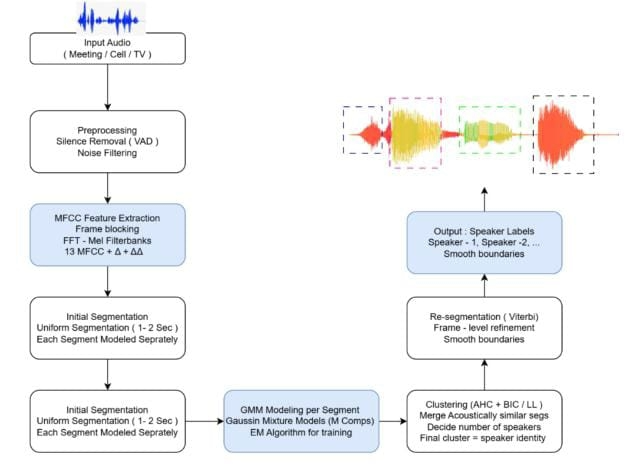
Automatic Speaker Diarization (ASD) is the process of dividing an audio recording into regions where each speaker is the same and figuring out "who spoke when" with-out knowing who the speakers are ahead of time. It is a necessary part of meeting transcription, conversational analytics, indexing for broadcast media, forensic audio processing, call-center monitoring, and modern systems for human-computer interac-tion. In the past twenty years, diarization research has moved from traditional statis-tical models like Gaussian Mixture Models (GMMs) based on MFCCs and Bayesian Information Criterion (BIC) segmentation to more advanced representation learning methods like i-vectors and Probabilistic Linear Discriminant Analysis (PLDA). Later advances in deep learning led to strong neural embeddings like x-vectors and ECAPA-TDNN, which made it much easier to identify speakers in difficult sound situations. The most current Self-Supervised Learning (SSL) models, such as Wav2Vec 2.0, HuBERT, and WavLM, have set new standards by learning strong speech representations without any labeled input. End-to-End Neural Diarization (EEND), UIS-RNN, and VB-HMM re-segmentation are some of the complementary methods that have improved how well we can handle overlaps and refine time.
This evaluation offers a thorough examination of recent advancements, evaluat-ing the advantages and disadvantages of prominent diarization methodologies, pin-pointing enduring research deficiencies, and delineating prospective avenues for the enhancement of precise, multilingual, and real-time speaker diarization systems.
Downloads
Published
How to Cite
Issue
Section
License

This work is licensed under a Creative Commons Attribution-NoDerivatives 4.0 International License.
