A Survey of Methods and Architectures for Dual-discriminator Spiking Generative Adversarial Network Based Classification and Segmentation for Predicting Pathogenesis of Foot Ulcers in Patients with Diabetes
DOI:
https://doi.org/10.65521/ijacect.v14i2.2752Keywords:
Abstract
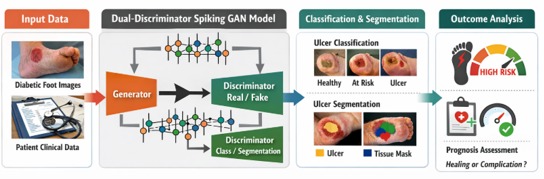
Diabetic foot ulcers represent a severe complication of diabetes, often leading to infection, amputation, and increased mortality if not detected and treated early. Recent advances in artificial intelligence have enabled the development of sophisticated models for automated diagnosis and prognosis, particularly through deep learning-based classification and segmentation techniques. Among these, generative adversarial networks have shown promise in enhancing data representation and improving predictive accuracy. This survey explores emerging methodologies centered on dual-discriminator spiking generative adversarial networks, which combine biologically inspired spiking neural mechanisms with adversarial learning paradigms. The integration of dual discriminators facilitates improved feature validation and robustness in both classification and segmentation tasks. The paper systematically reviews current architectures, training strategies, and applications in diabetic foot ulcer prediction. Furthermore, it highlights the role of multimodal data, including medical imaging and clinical metadata, in improving model generalization. Challenges such as data scarcity, model interpretability, and computational complexity are also discussed. The survey concludes by outlining future research directions aimed at enhancing model efficiency, reliability, and clinical applicability in real-world healthcare systems.