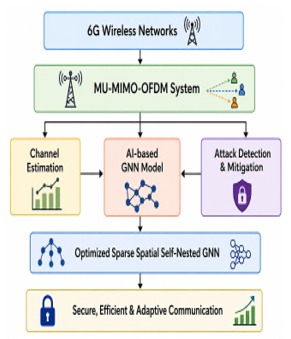
Artificial Intelligence Techniques for an Optimized Sparse Spatial Self-Nested Graph Neural Network for Secure MU-MIMO-OFDM System: Channel Estimation, Attack Detection and Mitigation – Trends and Challenges
DOI:
https://doi.org/10.65521/ijacect.v14i2.2744Keywords:
Abstract
The rapid evolution of 6G wireless communication systems has intensified the need for intelligent, secure, and efficient signal processing techniques in MU-MIMO-OFDM systems. Artificial Intelligence (AI), particularly deep learning models such as Graph Neural Networks (GNNs), Convolutional Neural Networks (CNNs), and Reinforcement Learning (RL), has emerged as a promising solution for addressing challenges in channel estimation, attack detection, and mitigation. Among these, optimized sparse spatial self-nested GNN architectures have demonstrated significant potential in modelling complex wireless environments by capturing spatial dependencies and interference patterns. This paper presents a comprehensive review of AI-driven techniques for secure MU-MIMO-OFDM systems, focusing on advancements. The study highlights the role of sparse learning, attention mechanisms, and hybrid AI models in improving system performance and reducing computational complexity. Additionally, it explores AI-based security frameworks for detecting and mitigating adversarial attacks such as jamming and spoofing. The review also identifies key trends, including the integration of GNNs with optimization algorithms and edge intelligence, as well as challenges such as scalability, real-time deployment, and robustness against evolving threats. A comparative analysis of existing approaches is provided, along with future research directions for developing intelligent and secure 6G communication systems.