
AI-Driven Secure Hybrid MANET for Tactical Communication in Infrastructure-Free Zones
DOI:
https://doi.org/10.65521/ijacect.v14i3s.1611Keywords:
Abstract
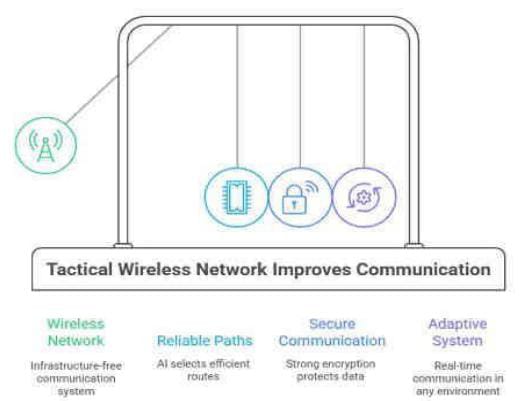
In critical situations such as military missions, natural disasters, or rural operations, reliable communication can decide the difference between success and failure. However, most traditional communication systems depend on existing infrastructure such as mobile towers or internet connectivity, which may fail or be unavailable in such areas. This paper presents an AI-driven tactical wireless communication system that enables devices to communicate without any fixed infrastructure, forming a self-organizing Mobile Ad-Hoc Network (MANET). The system uses hybrid communication protocols—Wi-Fi Direct, Bluetooth, and LoRa—to achieve both short-range and long-range communication. To ensure the network remains stable and efficient, an AI-based Q-learning routing algorithm dynamically selects the best communication path between nodes. The prototype was implemented using ESP32 microcontrollers, LoRa SX1278 modules, and a custom Android application. Security is achieved through AES-256 encryption, SHA-256 hashing, and blockchain- inspired message verification. Experimental results show significant improvements in throughput, reliability, and recovery time compared to traditional routing methods. The system demonstrates a promising step toward secure, intelligent, and infrastructure-free communication for tactical and emergency use.
Downloads
Published
How to Cite
Issue
Section
License

This work is licensed under a Creative Commons Attribution-NoDerivatives 4.0 International License.
