A Comprehensive Review of Dynamic Path-Controllable Deep Unfolding Networks to Predict the K-Barriers for Intrusion Detection Using a Wireless Sensor Network
DOI:
https://doi.org/10.65521/itsi-teee.v14i1.2802Keywords:
Abstract
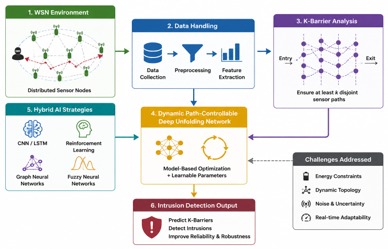
Wireless Sensor Networks (WSNs) have emerged as essential technologies for intrusion detection, surveillance, border monitoring, and critical infrastructure protection due to their capability to provide continuous and distributed sensing in dynamic environments. Among various coverage models, k-barrier coverage plays a crucial role in ensuring reliable intrusion detection by guaranteeing that an intruder crossing a monitored region is detected by at least k sensors. Recent advancements in artificial intelligence and deep learning have significantly improved k-barrier prediction and optimization in WSNs. In particular, Dynamic Path-Controllable Deep Unfolding Networks (DPDUNs) have gained attention for integrating iterative optimization algorithms with learnable deep neural architectures to improve prediction accuracy and adaptive decision-making. These models dynamically adjust sensing and routing strategies according to changing network conditions, enabling efficient intrusion detection in resource-constrained environments. Recent studies have also explored hybrid CNN-LSTM models, reinforcement learning frameworks, graph neural networks, fuzzy neural systems, and federated learning approaches for scalable and intelligent k-barrier management. Research findings indicate that hybrid deep unfolding frameworks significantly improve prediction accuracy, adaptability, and barrier robustness compared with traditional rule-based or statistical approaches. However, challenges related to computational complexity, energy consumption, scalability, and real-time deployment remain major research concerns in next-generation WSN intrusion detection systems.