A Comprehensive Review of An Effective Progressive Dense Self-Attention based Human Resource Recommendation for Predicting Employee Turnover
DOI:
https://doi.org/10.65521/ijeecs.v12i2.2648Keywords:
Abstract
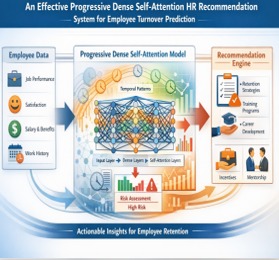
Employee turnover prediction has become a critical research area in modern human resource analytics due to its direct impact on organizational performance, productivity, and cost management. Traditional statistical and machine learning approaches often fail to capture complex temporal dependencies and nonlinear relationships inherent in workforce data. Recent advancements in deep learning, particularly attention mechanisms and dense architectures, have opened new avenues for improving predictive accuracy and interpretability. This paper presents a comprehensive review of an effective Progressive Dense Self-Attention based Human Resource Recommendation framework designed to predict employee turnover. The proposed paradigm integrates dense feature propagation with self-attention mechanisms to enhance representation learning while preserving contextual dependencies across employee attributes. Progressive learning strategies further enable hierarchical refinement of features, improving model generalization. The review systematically examines existing literature, identifies methodological gaps, and highlights the advantages of combining dense connectivity with attention-based models in HR analytics. Furthermore, the study explores the role of recommendation systems in providing actionable insights for retention strategies. The findings suggest that integrating progressive dense architectures with self-attention significantly enhances predictive performance and decision support capabilities. This paper concludes by outlining future research directions, emphasizing explainable AI, real-time analytics, and adaptive workforce management systems.