Artificial Intelligence Techniques for Early Detection and Segmentation of Diabetic Foot Ulcer Risk Zones Using a Cycle-Consistent Adversarial Adaptation Network from Multimodal Images: Trends and Challenges
DOI:
https://doi.org/10.65521/ijeecs.v12i2.2642Keywords:
Abstract
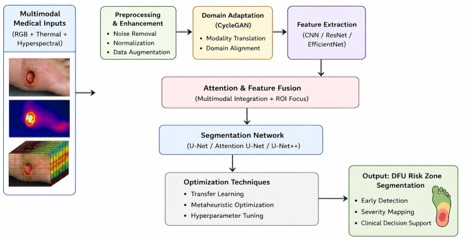
Diabetic Foot Ulcers (DFUs) are among the most severe complications of diabetes mellitus, often leading to infection, hospitalization, and lower-limb amputation if not detected at an early stage. Accurate identification and segmentation of DFU risk zones are therefore critical for timely intervention and effective treatment planning. Recent advancements in Artificial Intelligence (AI), particularly deep learning, have significantly improved the automation and reliability of DFU diagnosis using medical imaging techniques. This study presents a comprehensive review of AI-based methods for early detection and segmentation of DFU risk regions, with a specific focus on Cycle-Consistent Adversarial Adaptation Networks and multimodal image analysis. Multimodal imaging, including RGB, thermal, and hyperspectral data, provides complementary information for detecting subtle physiological and structural changes in diabetic feet. However, challenges such as limited annotated datasets, modality imbalance, and domain variability hinder the performance of conventional deep learning models. To address these issues, CycleGAN-based adversarial adaptation techniques enable effective cross-domain learning and unpaired image-to-image translation, thereby enhancing model generalization and reducing dependence on labeled data.
This review highlights the role of key AI techniques, including Convolutional Neural Networks (CNNs), Generative Adversarial Networks (GANs), Vision Transformers, and hybrid architectures, in improving segmentation accuracy and detection performance. Optimization strategies such as transfer learning, attention mechanisms, and feature fusion further contribute to enhanced model efficiency and robustness. Despite significant progress, challenges related to computational complexity, interpretability, and real-world deployment remain.