
A Systematic Review of Topology-Based Models for Protein–Protein Interaction Networks: Methods, Architectures, and Future Research Directions
DOI:
https://doi.org/10.65521/ijeecs.v14i2.2139Keywords:
Abstract
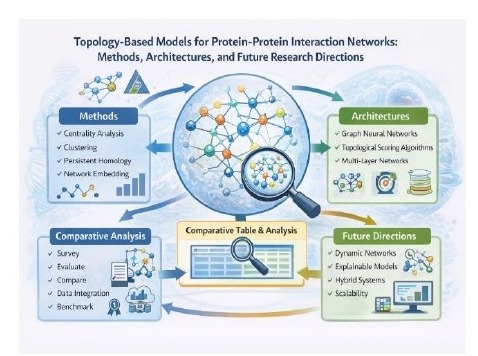
Protein–protein interaction (PPI) networks play a crucial role in understanding cellular processes, disease mechanisms, and drug discovery. Topology-based models have emerged as powerful tools for analysing the structural and functional organization of these networks by leveraging graph theory, network science, and topological data analysis. This systematic review examines advances from 2018 to 2023 in topology-based modelling of PPI networks, focusing on methodologies, computational architectures, and emerging research directions. The review explores classical graph-theoretic approaches, including centrality measures, clustering, and modularity detection, alongside advanced techniques such as persistent homology, network embedding, and graph neural networks (GNNs). Special attention is given to algorithms for protein complex detection, topological scoring, and multi-scale network analysis. The findings indicate that while traditional topological models provide strong interpretability and biological relevance, modern hybrid approaches integrating machine learning and topological features significantly enhance prediction accuracy and scalability. However, challenges remain in handling noisy datasets, dynamic interactions, and computational complexity. Future research directions include topology-driven deep learning frameworks, multi-layer biological networks, and interpretable AI models for PPI analysis. This review provides a comprehensive foundation for developing next-generation topology-aware computational frameworks in systems biology.
Downloads
Published
How to Cite
Issue
Section
License

This work is licensed under a Creative Commons Attribution-NoDerivatives 4.0 International License.
