
Synthesis and Characterization of Nanostructured Inorganic Materials for Energy Storage Devices
DOI:
https://doi.org/10.65521/ijasret.v10i1.2018Keywords:
Abstract
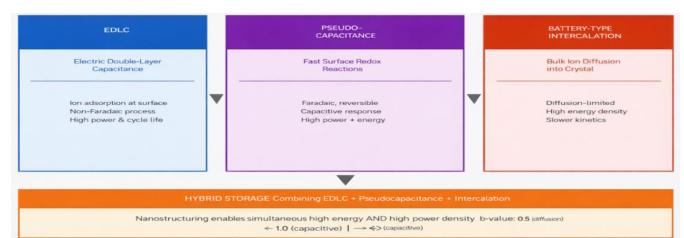
The exponential growth in global energy demand, coupled with the rapid depletion of fossil fuel reserves and the urgent need to address climate change, has spurred intense research interest in efficient, sustainable energy storage systems. Nanostructured inorganic materials have emerged as highly promising candidates for next-generation energy storage devices, offering unique physicochemical properties that cannot be achieved with their bulk counterparts. Their exceptionally high surface-area-to-volume ratios, tunable electronic structures, short ion-diffusion pathways, and enhanced charge-transfer kinetics position them as transformative components in batteries, supercapacitors, and hybrid energy storage devices. Despite remarkable progress, the field faces persistent challenges including inadequate long-term cycling stability, complex and expensive synthesis routes, limited scalability for industrial production, poor understanding of nanoscale electrochemical degradation mechanisms, and toxicity concerns associated with certain nanomaterials. Achieving simultaneous improvements in energy density, power density, coulombic efficiency, and operational lifetime remains a central challenge. This review systematically examines state-of-the-art synthesis strategies—including hydrothermal/solvothermal methods, sol-gel processing, chemical vapor deposition (CVD), atomic layer deposition (ALD), and electrochemical deposition—for producing nanostructured metal oxides, sulfides, carbides, and composite architectures. Morphological control, surface engineering, and heterostructure design principles are critically analyzed. Key findings demonstrate that carefully engineered nanostructures—zero-dimensional quantum dots, one-dimensional nanowires/nanotubes, two-dimensional nanosheets, and three-dimensional hierarchical architectures—exhibit specific capacitances exceeding 500 F/g, energy densities surpassing 60 Wh/kg, and cycle lives beyond 10,000 charge-discharge cycles. Metal-organic framework (MOF)-derived carbons and MXene-based composites show particular promise for next-generation applications.Nanostructured inorganic materials represent the vanguard of energy storage research. Future success hinges on bridging the gap between laboratory-scale synthesis and industrial manufacturing, developing green synthesis protocols, and employing computational materials design to accelerate discovery. The convergence of advanced characterization tools, machine learning, and novel nanomaterial chemistries is expected to catalyze breakthrough developments in energy storage technology within the coming decade.
Downloads
Published
How to Cite
Issue
Section
License

This work is licensed under a Creative Commons Attribution-NoDerivatives 4.0 International License.
